
1. Start With Yourself, Not the Mattress
Before you look at a single product page, answer three questions about yourself: How do you mostly sleep — on your side, back, stomach, or a combination of all three? Do you sleep hot? And do you share the bed with a partner, a pet, or both?
Sleep position matters most when it comes to firmness. Side sleepers need more give at the shoulder and hip — typically a medium (5–6 out of 10) or medium-soft. Back sleepers usually do best in the medium-firm range (6–7 out of 10), where the lumbar spine gets support without the hips sinking too far. Stomach sleepers need firmer support (7+ out of 10) to keep the spine from bowing downward. Combination sleepers — the most common type — usually land in the medium range and do especially well on responsive materials that make it easy to change position without feeling stuck.
Quick Firmness Reference
- Side sleeper → Medium-soft to Medium (4–6/10)
- Back sleeper → Medium-firm (6–7/10)
- Stomach sleeper → Firm (7–8/10)
- Combination sleeper → Medium (5–6/10) on a responsive surface
2. Understanding Firmness (And Why the Scale Is Subjective)
The 1–10 firmness scale you'll see on every product page has no industry standard behind it. A "6" from one brand can feel like a "7" from another. What matters more is understanding the variables that influence how a mattress actually feels on your body.
- Your body weight changes how a mattress feels. Lighter sleepers experience mattresses as firmer because they don't compress the foam or coils as deeply. Heavier sleepers sink in more and may find a "medium" feels closer to medium-soft in practice.
- The materials under the comfort layer matter as much as the top layer. A mattress with a firm coil base and a plush pillow top feels different from an all-foam bed at the same listed firmness.
- "Medium" is the most commonly offered option across brands — it suits the widest range of sleepers, which is exactly why every brand makes one.
Rather than fixating on the number, read the brand's own language about who the mattress is designed for. That tells you more than the scale.
3. Mattress Types — The Short Version
You don't need a PhD in foam chemistry. Here's what actually matters about each major construction type:
Memory Foam
Outstanding pressure relief and excellent motion isolation — great if your partner moves around at night. The tradeoff: memory foam traps more heat than other materials, and the slow-response feel means some sleepers feel "stuck" when changing positions. Best for: side sleepers, light sleepers who share a bed.
Hybrid
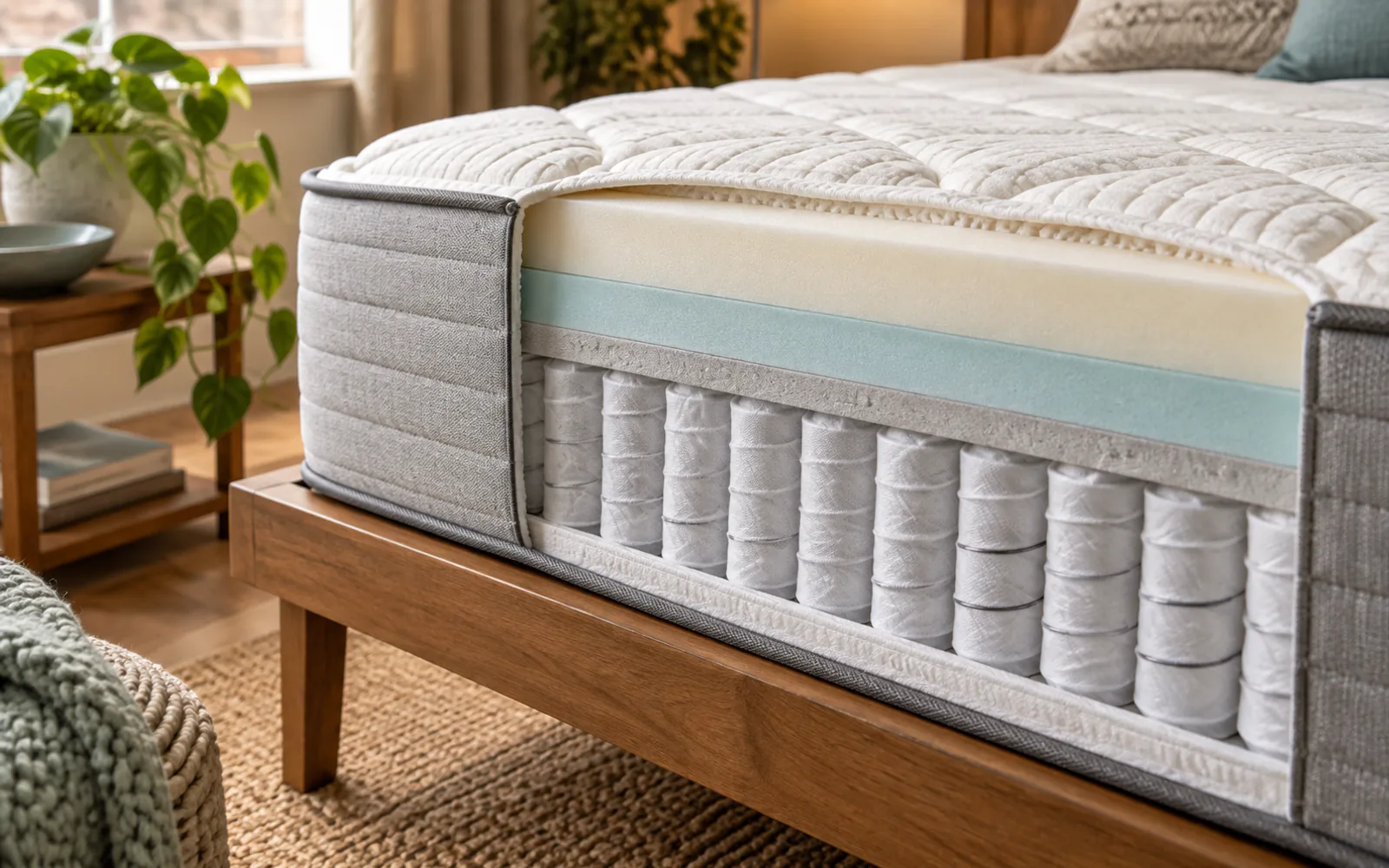
A foam or latex comfort layer over a pocketed coil support core. More responsive than all-foam, better airflow thanks to the coils, and typically stronger edge support. The most versatile option. Best for: combination sleepers, hot sleepers, heavier individuals, anyone who wants bounce.
Latex
Natural or synthetic rubber. Bouncy and responsive in a way that's distinct from memory foam — it pushes back rather than contouring around you. Naturally cooling and extremely durable. Best for: eco-conscious buyers, hot sleepers, those who want pressure relief without the memory foam "hug."
Innerspring
Traditional coil construction with little or no foam comfort layer. Excellent airflow and bounce, but limited pressure relief. Best for: traditional sleepers, stomach sleepers who need firm support, those who strongly prefer a bouncy surface.
Explore mattresses by type — memory foam, hybrid, latex, and more.
Shop by type →4. The Trial Period Is Your Best Friend
Almost every major online mattress brand offers a sleep trial — typically 100 nights. This is genuinely your safety net, and you should treat it as such. You cannot truly evaluate a mattress by lying on it for 90 seconds in a showroom. Your body takes two to four weeks to adjust to a new sleep surface, and you need that time to form an accurate opinion.
- Most brands require a minimum trial period — usually 30 nights — before you can initiate a return. This is to give your body time to adjust before you judge the mattress.
- Returns are typically free. The brand sends someone to pick it up, and the mattress is often donated or recycled.
- Some brands, especially at the premium end, charge a restocking fee. Read the fine print before you buy.
- A trial period under 90 nights is a yellow flag. The industry standard is 100 nights; many brands offer 120 or 365.
5. What to Ignore — Marketing Fluff
- "Orthopedic" — Not a regulated term. Any brand can print it on a mattress. It means nothing without independent certification.
- "Luxury foam" — Meaningless. Ask instead whether the foam has CertiPUR-US certification, which verifies it's been tested for harmful chemicals, heavy metals, and formaldehyde.
- Coil count — More coils does not automatically mean better support. Coil gauge (thickness) and construction type matter far more than raw count.
- "Cooling technology" — Some cooling features are real and measurable: copper-infused foam, open-cell foam, phase-change material covers, natural latex. Others are pure marketing. When in doubt, look for hybrid construction with coils, which provides genuine airflow.
6. What Actually Matters
- CertiPUR-US: The baseline certification for any foam mattress. Verifies the foam has been tested for harmful substances.
- GOLS (Global Organic Latex Standard): Relevant if you're buying a latex mattress. Confirms the latex is certified organic.
- GREENGUARD Gold: Tests for over 10,000 chemical emissions. Especially important if you have chemical sensitivities or are buying for a child.
- Trial period: 90+ nights is the standard. Anything less is worth questioning.
- Warranty: 10 years is the baseline. Lifetime warranties exist on some premium beds and are a genuine signal of manufacturer confidence.
- Firmness options: Does the brand offer more than one firmness level? Can you exchange if you choose wrong? The best brands make this easy.
7. Setting a Budget — What the Tiers Actually Look Like
The right budget depends entirely on your situation — how long you plan to keep this mattress, what you need from it, and what you can comfortably spend right now. Here's what each price tier actually delivers, so you can match your investment to your real needs:
Under $700 — Budget Tier
Fine for a guest room, a college dorm, or a short-term living situation. Materials are functional but use lower-density foams that typically break down within 3–4 years. Don't plan on this being your primary bed for the long haul.
$700–$1,400 — Quality Materials, Real Warranties
You'll find higher-density foams, pocketed coil hybrids, and established brands with the infrastructure to honor their warranties. A strong range for most sleepers — not because you have to be here, but because the value-to-quality ratio is excellent at this tier.
$1,400–$2,500 — Step Up
Premium materials or handcrafted construction. Worth it if you plan to keep this bed for 8–10 years and want natural materials, more sophisticated coil systems, or higher-end brands. The math often works out in your favor over time.
$2,500+ — Legitimate Luxury
Real luxury territory — proprietary foams, natural fiber fillings, white-glove delivery. Worth exploring once you know what you like and what sleep feels like when it's excellent. A fine choice for a forever bed.
The best mattress is the one that fits your needs, your sleep style, and your life — not a specific price point. Start with what you know about how you sleep, use the budget tiers as a reference, and let your priorities guide the rest.
Looking for quality mattresses under $1,000? Filter by price in our full mattress database.
Browse by price →Not sure which type fits your sleep style? Take our 2-minute quiz.
Find my match →Exploring premium options? Our luxury sleep system guide covers everything from $2,500 and up.
Read the luxury guide →Not sure where to start?
Take our quick sleep quiz and we'll match you with mattresses that fit your sleep style and budget — no jargon, no upsell.
Find your perfect sleep →