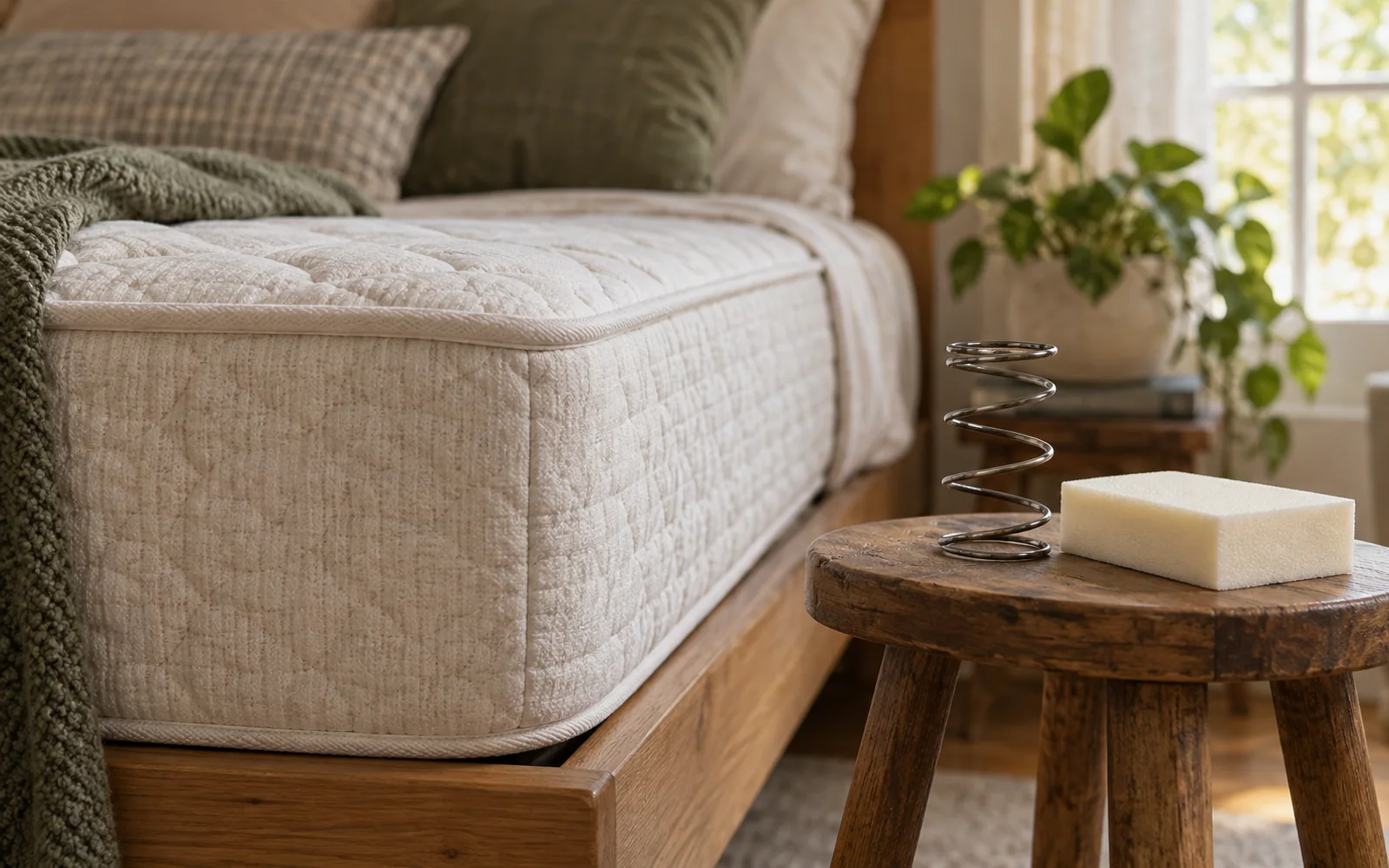
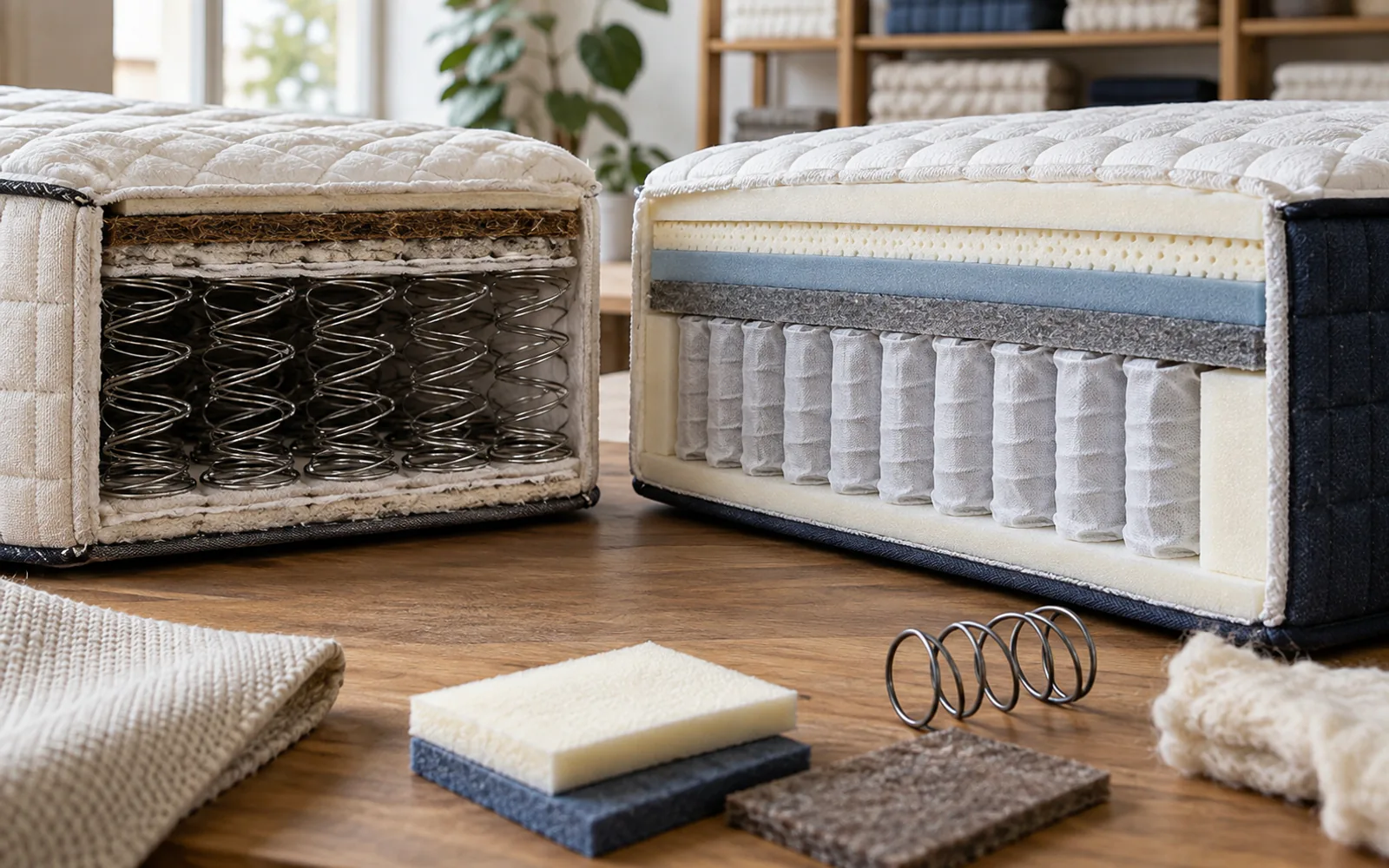
1. What a True Innerspring Actually Is
A true innerspring mattress uses a coil system as both the support structure and the primary comfort layer. The coils do most of the work — you're essentially sleeping on a spring system with a thin quilted cover on top. This was the dominant mattress design for most of the 20th century.
The feel is unmistakable: firm, bouncy, very responsive, excellent airflow, and little contouring. You don't sink into a true innerspring — you sleep on top of it. Edge support is generally strong. Motion isolation is generally poor (coils transfer movement easily). Noise (squeaking) can be a long-term issue as coils age.
True Innerspring Characteristics
- Coil system provides both support AND primary comfort — minimal foam layering
- Firm, bouncy, responsive feel — you sleep on top of the mattress
- Excellent airflow — coils create natural air channels throughout
- Poor motion isolation — coils transfer movement easily to the other side
- Strong edge support — coils go to the perimeter
- Potential for noise over time as coil joints age
Today, true innersprings are actually rare. Aireloom is one of the few mainstream brands still making them. Most 'innerspring' products at retail have been quietly redesigned as hybrids.
2. What a Hybrid Actually Is
A hybrid mattress has two distinct layers: a coil support core at the bottom (the 'innerspring' component) and foam, latex, or gel comfort layers on top. The foam layer is typically 2–5 inches thick. This combination gives you the structural benefits of coils — support, airflow, edge support, durability — while the foam layer provides contouring, pressure relief, and improved motion isolation.
The key distinction from true innerspring: in a hybrid, you primarily feel the foam comfort layer, not the coils. The coils are doing structural work in the background. In a true innerspring, you're in much more direct contact with the spring system.
The Hybrid Formula
Hybrid = coil support core (bottom 6–8") + foam/latex comfort layer (top 2–5"). The comfort layer determines the feel. The coil core determines the structure, durability, and support.
3. Why Most 'Innerspring' Brands Are Now Hybrids
Beautyrest, Sealy Posturepedic, Serta, and Stearns & Foster all added substantial foam comfort layers to their traditional coil constructions — and that change, by definition, makes them hybrids. They still market themselves with their coil heritage ("Beautyrest's signature pocketed coil system"), but technically, if there's a meaningful foam comfort layer above the coils, it's a hybrid.
Traditional Brands Now Selling Hybrids
- Beautyrest Harmony Lux, Black series (C, K, X-Class) → hybrid — foam comfort layers over coil core
- Sealy Posturepedic Plus Hybrid → hybrid — explicitly named in their own marketing
- Serta iComfortECO, iComfort Arctic, Perfect Sleeper → hybrid — foam layers over coil support
- Stearns & Foster Estate, Reserve, Lux Estate → hybrid — thick foam/latex comfort layers over coils
- Cocoon by Sealy Chill Hybrid → hybrid — Sealy's online brand explicitly calls it hybrid
This isn't a criticism of these brands — it's simply an accurate description of their products. The move toward hybrid construction reflects genuine consumer demand: people wanted more cushioning and pressure relief than pure coil mattresses provided. The hybrid design delivers both.
4. How They Actually Feel Differently
The primary difference you'll notice isn't in the coil system — it's in what's sitting on top of it.
Side-by-Side: Feel Differences
- Responsiveness: Both are more responsive than memory foam. True innerspring feels bouncier and more immediate. Hybrids have slight give from the foam before the coil response kicks in.
- Pressure relief: Hybrids win, usually by a significant margin. The foam layer contours to the body. True innerspring has minimal contouring.
- Motion isolation: Hybrids are meaningfully better, especially those with individually pocketed coils. True innerspring with interconnected coils transfers movement easily.
- Cooling: True innerspring has a slight edge — more direct airflow. Hybrids with good open-cell foam or latex are close.
- Edge support: Both are typically good. Reinforced edge coils in both designs perform similarly.
- Noise: Hybrids age more quietly — the foam absorbs stress on the coil connections. True innerspring with bonnel coils can squeak over time.
5. Does It Actually Matter Which You Choose?
For most modern buyers — probably not in the way you might think. The practical differences that affect daily sleep quality are:
- If you want maximum pressure relief: Choose a hybrid with a thicker comfort layer. True innerspring won't give you this.
- If you want the most responsive, traditional coil feel with minimal foam: Seek out a true innerspring — Aireloom makes the best available.
- If you share a bed: A hybrid with pocketed coils is noticeably better for motion isolation than a traditional bonnel-coil innerspring.
- If you sleep hot: True innerspring has a slight edge in airflow, but a hybrid with good breathable foam is very close. Temperature difference is rarely the deciding factor.
- If you have back pain: Hybrids provide more options — you can choose a thicker comfort layer for pressure relief while the coil core provides support. True innerspring is often too firm for side sleepers with hip or shoulder pain.
6. The Pricing Reality
In the market today, hybrids span the full price range — from $500 budget options to $5,000+ luxury models. True innersprings at major brands tend to be either budget options (basic bonnel coil construction) or specialty/artisan products (Aireloom, hand-tufted innerspring at the high end). The mid-market is almost entirely hybrid.
Price Guidance by Type
Budget hybrid ($500–$900): Good value, pocketed coils, basic foam comfort layer. Traditional brand hybrid ($900–$2,500): Sealy, Serta, Beautyrest, Stearns — more extensive coil systems and thicker comfort layers. DTC hybrid ($800–$2,000): Helix, Casper, Purple, WinkBed — competitive construction at transparent pricing. True innerspring (varies): Budget options under $500 exist. High-end traditional innerspring (Aireloom) runs $2,000+.
7. How to Tell Which You're Buying
- Read the layer description: If the spec sheet mentions 'foam comfort layer,' 'memory foam top,' or 'gel foam' anywhere above the coils, it's a hybrid.
- Look for total comfort layer thickness: A true innerspring will have 1" or less of quilting/padding above coils. Anything thicker (2"+ of foam) is a hybrid.
- Check the brand's own language: Sealy explicitly calls their hybrid models 'Hybrid' in the product name. Beautyrest uses 'Hybrid' on their foam-layered models too.
- Ask about the coil type: Pocketed (individually wrapped) coils suggest hybrid construction, as the pocketing technology evolved alongside foam layering. Old-school bonnel (hourglass interconnected) coils are more often found in true innerspring.
- When in doubt, assume hybrid: If you're looking at any product from Beautyrest, Sealy, Serta, or Stearns & Foster and it costs more than $600, it almost certainly has meaningful foam layers above the coils.
Browse our full innerspring category — 7 verified pure innerspring mattresses.
Browse Innerspring →Browse our full hybrid category — 120 verified hybrid and latex-hybrid mattresses.
Browse Hybrids →Not sure which type is right for your sleep position and budget? The quiz factors this in.
Take the quiz →Not sure where to start?
Take our quick sleep quiz and we'll match you with mattresses that fit your sleep style and budget — no jargon, no upsell.
Find your perfect sleep →