
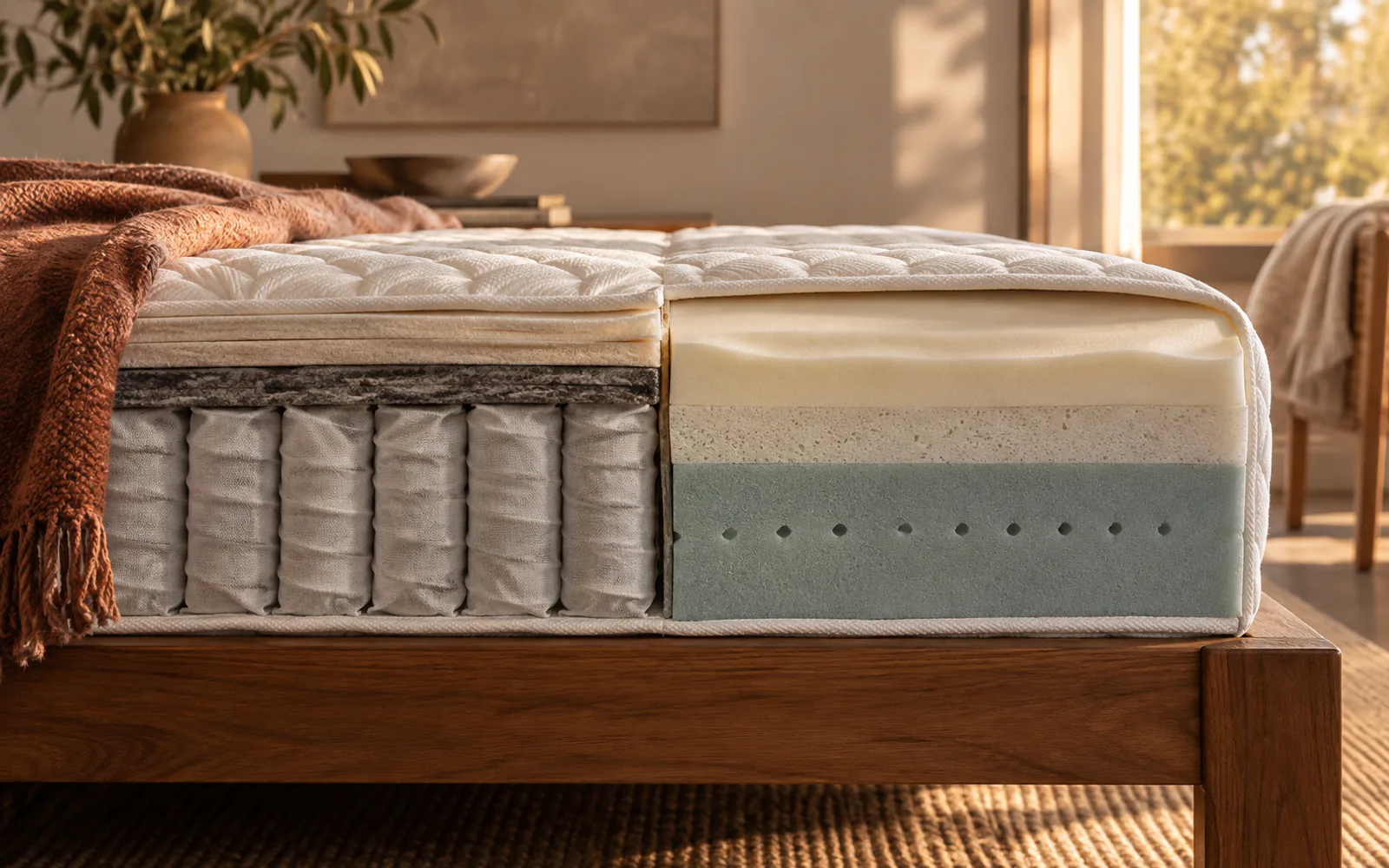
1. Why Your Mattress Type Changes Everything
Every mattress type has a distinct feel, and that feel directly affects intimacy. The four factors that matter most are responsiveness (how quickly the surface springs back), noise, edge support, and temperature. Get all four right for your preferences, and the mattress becomes an afterthought — which is exactly what you want.
2. Innerspring: The Classic for a Reason
Traditional innerspring mattresses — Bonnell or offset coil construction — are bouncy in the most literal sense. The coils compress and release quickly, creating a responsive, energetic surface. If you grew up on one, you probably have a baseline expectation that a mattress should move with you. That expectation is reasonable and valid.
- Responsiveness: Excellent — coils compress and rebound quickly with movement.
- Noise: The Achilles heel of older innersprings. Bonnell coils connect via a helical wire and can squeak over time. Pocketed coil systems are dramatically quieter.
- Edge support: Typically strong — reinforced perimeters are common, keeping the usable surface area generous.
- Temperature: Innersprings run cooler than foam thanks to air circulating between coils.
Switching Away From Innerspring?
The biggest adjustment for couples is that memory foam doesn't push back. That 'stuck in the surface' feeling some foam skeptics describe is real and it takes adjustment. If you love the bounce of an innerspring but want better pressure relief, a hybrid is almost always the right answer.
3. Memory Foam: The Honest Trade-Off
Memory foam is the best material in the world at absorbing motion. It's also among the worst at responding to it. The viscoelastic structure that makes it so good at pressure relief — it deforms slowly under heat and weight — is the same structure that makes it sluggish to rebound. For sleeping, that's a feature. For intimacy, some people find it frustrating.
- Responsiveness: Low — the material absorbs energy rather than returning it, creating a 'quicksand' sensation some find unflattering.
- Noise: Essentially silent — no coils, no springs, nothing to creak.
- Edge support: Generally weak on all-foam beds unless the perimeter foam is specifically reinforced. Sitting or moving near the edge can feel unstable.
- Temperature: Foam traps heat. Open-cell, gel-infused, or copper-infused versions help but don't fully eliminate this.
If you currently sleep on memory foam and notice the surface feeling slow, you're not imagining it. This is physics. The solution isn't to lower your expectations — it's to switch materials.
4. Hybrid: The Performance Sweet Spot
A hybrid mattress — foam or latex comfort layers over pocketed coils — is consistently the most well-rounded option for couples. The coils provide responsiveness and airflow; the comfort layer provides pressure relief and noise dampening. The combination addresses nearly every complaint from both the innerspring and memory foam camps.
Hybrid Performance Report Card
- Responsiveness: Good to Excellent — coils return energy quickly, foam softens the feel.
- Noise: Low — pocketed coils operate independently and rarely squeak.
- Edge support: Strong — coil perimeters hold their shape, maximizing usable surface.
- Temperature: Good — coil airflow keeps the sleep surface significantly cooler than all-foam.
If you're upgrading from a squeaky old innerspring and want to keep the responsiveness while eliminating the noise, a pocketed coil hybrid is the upgrade you're looking for.
5. Latex: Responsive Without the Spring
Natural latex occupies an interesting niche: it's highly responsive like an innerspring, but the response feels smooth and controlled rather than bouncy. Think of it as the difference between a trampoline and a gymnastics mat — both have give, but the feel is different in character.
- Responsiveness: Excellent — latex springs back quickly without the coil ping.
- Noise: Silent — no coils at all in an all-latex construction.
- Edge support: Variable — depends on construction. Dunlop latex is denser and provides better perimeter support than Talalay.
- Temperature: Naturally cooler than memory foam. Open-cell structure allows air movement.
6. Edge Support: More Important Than You Think
Edge support is the most underrated spec on a mattress page and one of the most relevant for couples. Weak edge support dramatically reduces usable surface area — the edges compress under weight and feel unstable, pushing activity toward the center of the bed. Strong edge support means the entire mattress footprint is available. On a Queen, that's 24 square inches of difference per side.
- Best edge support: Pocketed coil hybrids with reinforced perimeters (e.g., Saatva Classic, WinkBeds, DreamCloud).
- Worst edge support: All-foam beds without dedicated perimeter foam.
- Middle ground: Hybrid beds without explicit reinforced edges — still better than all-foam.
7. Size Up If You Can
This one is simple. A King gives each partner the equivalent of a Twin XL to themselves — 38 inches wide. A Queen gives each person 30 inches. That 8-inch difference is significant for both sleep quality and intimacy comfort. If your room can fit a King, the upgrade is worth it. California Kings offer the same width as a standard King but add 4 inches of length — useful for tall couples but not otherwise necessary.
See exact dimensions for every mattress size, plus minimum room size recommendations.
Mattress Sizes Guide →8. The Noise Problem (And How to Solve It)
Mattress noise is almost exclusively a coil problem. Bonnell and offset coils — the continuous wire systems used in traditional innersprings — develop squeaks as the metal fatigues and the connecting wires loosen. Pocketed coils (also called individually-wrapped coils) each move independently and don't squeak because they're not mechanically connected to each other.
- Loud mattress: Almost certainly a traditional innerspring with interconnected coils.
- Quiet upgrade: Any pocketed coil hybrid eliminates the squeak while keeping the responsiveness.
- Silent option: All-foam or all-latex — zero coils, zero mechanical noise.
- Don't forget the foundation: Box springs can squeak independently of the mattress. A slatted platform base or adjustable foundation typically solves this.
9. Quick Reference: Mattress Type vs. Intimacy Factors
Innerspring (traditional)
Responsiveness ★★★★★ | Noise ★★☆☆☆ | Edge Support ★★★★☆ | Cooling ★★★★☆
Pocketed Coil Hybrid
Responsiveness ★★★★☆ | Noise ★★★★☆ | Edge Support ★★★★★ | Cooling ★★★★☆
Memory Foam
Responsiveness ★★☆☆☆ | Noise ★★★★★ | Edge Support ★★☆☆☆ | Cooling ★★☆☆☆
Latex
Responsiveness ★★★★★ | Noise ★★★★★ | Edge Support ★★★☆☆ | Cooling ★★★★☆
10. Our Picks for Couples
Based purely on the factors above — responsiveness, low noise, strong edge support, and good temperature regulation — here are the categories to focus on:
- Best overall for couples: A pocketed coil hybrid in the medium-firm range. Balances motion isolation for sleep with responsiveness for intimacy. Look for brands with reinforced edge support callouts.
- Best if you run hot: A hybrid with a cooling cover (phase-change material or Tencel). Cooling matters more at higher body temperatures.
- Best motion isolation (partner still waking you): Memory foam or a hybrid with individually wrapped micro coils. Accept the trade-off in responsiveness.
- Best for couples with different firmness preferences: A Split King with two Twin XL mattresses — each side can be tuned independently. Some adjustable airbeds (Sleep Number, Saatva Solaire) achieve the same result without the split.
Our quiz considers partner preferences, temperature, and motion transfer to find your best match.
Take the Sleep Quiz →When two people can't agree on a single mattress, a Split King might be the answer.
Read: Split King Guide →Not sure where to start?
Take our quick sleep quiz and we'll match you with mattresses that fit your sleep style and budget — no jargon, no upsell.
Find your perfect sleep →