
What is the Nest Owl?
The Nest Owl Natural Latex Hybrid is Nest Bedding's current natural-material hybrid: a latex comfort mattress over a reinforced pocketed-coil support system. It sits beside the Sparrow and Raven hybrids and the all-foam Starling in Nest's current adult lineup.
The key idea is simple. The Owl gives shoppers the buoyant, quick-recovery feel of Natural Talalay latex, then uses an 8-inch USA-made coil unit for lift, airflow, and edge structure. It is not a slow memory-foam mattress. The comfort layer responds quickly when you move, so it is popular with sleepers who want pressure relief but dislike the stuck sensation some memory foam can create.
Nest sells the Owl in Plush, Medium, and Firm, and those are not just labels. The latex layer changes from 14 ILD Plush to 24 ILD Medium to 36 ILD Firm, which makes the Owl feel like three mattresses sharing the same chassis. Start with the Medium Owl if you want the safest default, then move softer or firmer when your sleep position makes that choice obvious.
That shared chassis is the reason the Owl is easier to evaluate than many broad mattress lines. The cover, transition foam, coil system, and base foam stay consistent, while the 3-inch latex layer changes the comfort profile. If you already know you like a buoyant mattress, the decision is mostly about pressure relief versus push-back. If you are moving from memory foam, the bigger question is whether you want the faster response that latex brings.
Materials and construction
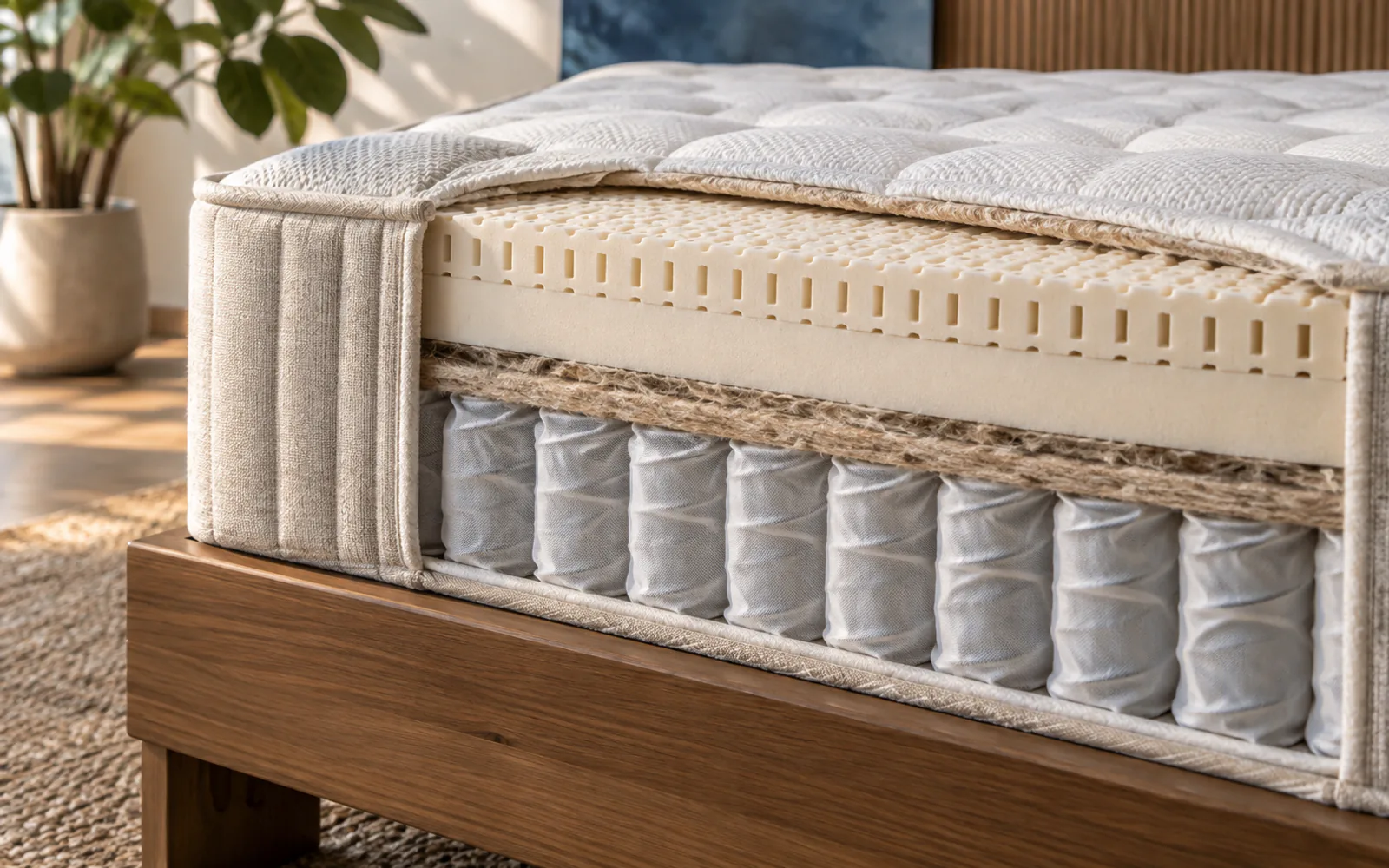
The Owl is 14 inches tall. Its top panel is a 1-inch organic stretch knit cotton cover with Joma wool and 1.5 lb eco-flex quilting foam. That cover gives the surface a lightly cushioned hand feel before you reach the latex, while the wool and cotton are part of the model's organic-leaning positioning.
Under the cover is the defining layer: 3 inches of Natural Talalay latex. Plush uses 14 ILD latex, Medium uses 24 ILD latex, and Firm uses 36 ILD latex. Talalay latex is springier and faster to rebound than memory foam, so it compresses under pressure without holding a body impression in the same slow way. That is why the Owl can relieve shoulder and hip pressure while still feeling easy to move on.
Beneath the latex is a 1-inch 1.5 lb CertiPUR-US transitional comfort foam layer. Below that sits the 8-inch reinforced-edge USA-made pocketed-coil unit. The coils add support and help stabilize the perimeter. The bottom layer is 1 inch of 1.5 lb support foam. Nest lists CertiPUR-US certified foams, Natural Talalay latex, and assembly in the USA for this model.
The layer stack also explains why the Owl should not be treated as an all-natural latex mattress. It has a natural latex comfort layer and organic-leaning cover materials, but it also uses CertiPUR-US foam in the quilting, transition, and base layers. Shoppers who want latex plus coils are looking in the right place. Nest no longer lists its former all-latex Finch as an orderable current product.
Firmness and feel
Plush is the pressure-relief choice. It is commonly chosen by side sleepers who want the shoulder and hip to sink farther into the comfort layer, but who still want latex responsiveness instead of a slow memory-foam hug. If you are light to average weight and sleep mostly on your side, the Plush Owl is the softness lane.
Medium is the broadest match. It is popular with combination sleepers because the 24 ILD latex has enough give for side sleeping and enough push-back for back sleeping. It is also the most practical default for couples who cannot agree on Plush or Firm.
Firm is preferred by back sleepers, stomach sleepers, heavier sleepers, and anyone who wants the latex layer to feel more supportive than plush. The Firm Owl keeps the same coil chassis but uses 36 ILD latex, so the surface resists deeper compression more strongly.
Cooling and breathability
The Owl's cooling story comes from materials and construction rather than a heavy cooling-technology pitch. Latex is naturally more open and responsive than dense memory foam, the coil layer leaves room for air movement through the support core, and the cotton and wool cover avoids the dense surface feel that can trap heat in some foam beds.
Hot sleepers who specifically dislike memory foam usually have a clearer reason to consider the Owl than the Sparrow or Starling. The Owl does not promise a refrigerated feel; it is better described as breathable and temperature-neutral within Nest's lineup.
Motion isolation and edge support
Latex and coils are responsive, so the Owl will not mute motion the way a dense all-foam memory bed can. The advantage is easier movement; the compromise is that very motion-sensitive couples may notice more bounce than they would on a slower foam mattress.
Edge support is a stronger point because the coil unit is reinforced at the perimeter. That matters if you sit on the side of the bed, sleep close to the edge, or share a queen and need the full usable width. The Firm version will feel more stable at the edge than Plush because the upper latex compresses less.
Pricing and what you actually pay
The Owl is an upper-tier Nest model. The verified queen price in this review is $2,078.40, down from $2,598.00. That puts it above Raven and Sparrow's current sale price, while remaining below some luxury showroom latex hybrids that use similar natural-material language.
The question is whether you want Talalay latex enough to pay the premium. If you are mainly chasing the lowest current Nest price, Raven makes more sense. If you want the fastest-response comfort material in the lineup with coils underneath, the Owl is the more direct fit.
The pricing also has to be judged against firmness confidence. A shopper who picks the wrong feel may not care how strong the material story is. Plush, Medium, and Firm should be treated as separate decisions because their ILDs are materially different. The most expensive mistake would be choosing the latex hybrid for the right reasons but choosing a surface that does not match your dominant sleep position.
Trial, warranty, delivery
Nest lists a 365-night trial for the Owl. That long trial is useful for a latex hybrid because Talalay can feel noticeably different from memory foam, especially if you are used to a slow cradle. A few nights is rarely enough to know whether you prefer latex bounce.
Warranty coverage includes a limited lifetime warranty and a 20-year warranty on the coil system, and the mattress ships free. This review does not add unverified delivery timelines, setup promises, or removal services beyond the model facts supplied for the Owl, so the most important confirmed ownership terms are the trial, free shipping, the limited lifetime warranty, and the separate coil-system warranty.
The delivery decision should therefore be handled at checkout rather than inferred from this review. What matters editorially is that the mattress has a long adjustment window and a warranty structure that specifically calls out the coil system. For a 14-inch hybrid, those ownership terms are a meaningful part of the purchase case, but they do not replace choosing the correct firmness on day one.
How the Nest Owl compares
Nest Owl vs Saatva Classic
Nest Owl vs Saatva Classic is a latex-hybrid versus luxury innerspring comparison. Saatva Classic is commonly chosen by shoppers who want a more traditional innerspring profile, while Owl is preferred by shoppers who want Talalay latex as the main comfort material.
Nest Owl vs Avocado Green
Nest Owl vs Avocado Green is the natural-material cross-shop. Both appeal to shoppers avoiding a memory-foam-first feel. Owl's three Talalay ILD options make the firmness decision more explicit.
Owl inside the Nest lineup
Compared with the broader Nest Bedding lineup, Owl is the latex hybrid. Sparrow uses responsive foam over coils, Starling is all foam, and Raven is the lower-priced flippable hybrid.
Nest Owl FAQ
What is the Nest Owl Natural Latex Hybrid?
The Owl is Nest Bedding's flagship organic-leaning latex hybrid, built with a cotton and wool cover, a 3-inch Natural Talalay latex comfort layer, transitional foam, and reinforced-edge USA-made pocketed coils.
How firm is the Nest Owl?
Nest offers the Owl in Plush, Medium, and Firm. The latex comfort layer changes by ILD: 14 ILD for Plush, 24 ILD for Medium, and 36 ILD for Firm.
Is the Nest Owl good for side sleepers?
The Plush Owl is commonly chosen by side sleepers who want pressure relief without the slow, deep hug of memory foam. Medium can work for combination sleepers who spend some time on their side.
Does the Nest Owl use organic latex?
The Owl uses Natural Talalay latex and CertiPUR-US certified foams. It also has an organic stretch knit cotton cover with Joma wool.
How tall is the Nest Owl?
The Nest Owl Natural Latex Hybrid is 14 inches tall.
What is the Nest Owl queen price?
The verified queen price for the Owl is $2,078.40, down from $2,598.00.
How long is the Nest Owl trial and warranty?
Nest lists a 365-night trial, a limited lifetime warranty, and a 20-year warranty on the coil system for the Owl.
Bottom line
The Owl is the Nest mattress to start with when your priority is latex responsiveness over memory-foam contouring, but you still want the lift and airflow of a coil system. Plush, Medium, and Firm are meaningfully different because the Talalay ILD changes, so choose by sleep position rather than treating firmness as a minor preference.
For most shoppers, the Medium Nest Owl is the default. Side sleepers should look at Plush, while back, stomach, and heavier sleepers should give Firm a closer look.
For adjacent research, compare it against the Saatva Classic or the Avocado Green, then use the Nest Bedding brand page to place Owl beside Sparrow, Raven, and Starling.