
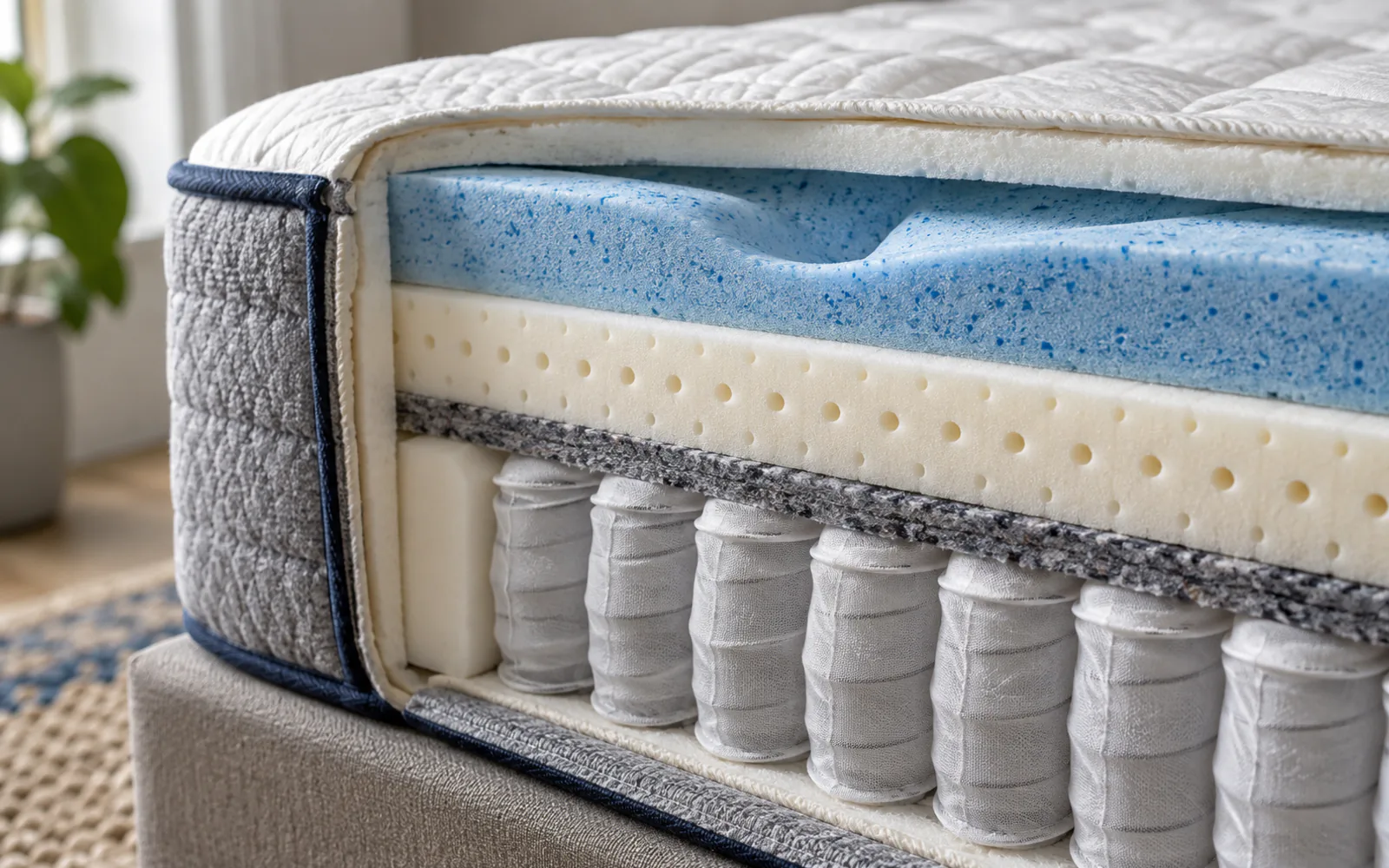
Foam Types
Memory foam (viscoelastic foam)
Polyurethane foam with added chemicals that make it temperature and pressure sensitive. It softens with body heat and conforms to your shape, then slowly returns to form when you move. The key properties are density (ILD) and response time. Higher density = more durable and better pressure relief, but more heat retention. Response time affects how quickly it adjusts when you change positions.
Polyfoam (polyurethane foam)
The most common mattress material — used in support cores and comfort layers. Less conforming than memory foam, faster response, lower cost. Quality varies enormously by ILD (Indentation Load Deflection) rating. Budget mattresses use low-density polyfoam (1.5–2 PCF) that degrades quickly. Quality support cores use 1.8–2.5 PCF.
Latex
Rubber-derived foam with natural springiness. Two types: natural latex (from rubber trees, more expensive, more durable, lower VOCs) and synthetic latex (petroleum-derived, more affordable, less durable). Two processing methods: Dunlop (denser, firmer, more affordable) and Talalay (lighter, more consistent, more expensive). Latex has the longest lifespan of any foam material and the lowest allergen risk.
Gel-infused foam
Memory foam or polyfoam with gel beads, gel swirls, or gel layers added. Marketed as cooling — the gel absorbs heat initially but saturates after a few hours. Genuine cooling benefit is modest and short-lived compared to copper-infused or open-cell foam alternatives. The term is frequently overmarketed.
Copper-infused foam
Foam with copper particles embedded. Marketed for cooling (copper is thermally conductive), antimicrobial properties, and sometimes muscle recovery. Thermal conductivity benefit is real but modest. Antimicrobial claims are legitimate. Recovery claims are not well-supported.
Graphite-infused foam
Similar to copper infusion — graphite is also thermally conductive and is used for heat dissipation in foam comfort layers. More thermally effective than gel for sustained cooling, though less marketed.
Open-cell foam
Foam with a more porous cellular structure that allows air to move through it more freely than traditional closed-cell foam. Significantly better cooling than traditional memory foam. Marketed by most premium memory foam brands.
Coil/Spring Types
Pocketed coils (individually wrapped coils)
Each coil is wrapped in its own fabric pocket, allowing coils to compress independently. The gold standard for hybrid mattresses. Dramatically reduces motion transfer compared to traditional innerspring. Coil count (500–2,000+ for a queen) matters, but coil gauge (thickness) matters more. Lower gauge number = thicker wire = firmer coil.
Bonnell coils
Traditional hourglass-shaped coils connected by a wire frame. The most affordable coil system. Motion transfers significantly between coils — not good for partners. Common in budget innerspring mattresses. Durability is adequate but not excellent.
Offset coils
Similar to Bonnell but with a hinged design that provides more body-conforming support. Better than Bonnell, cheaper than pocketed coils. Used in mid-range innerspring and some hybrid mattresses.
Micro coils (mini coils)
Very small pocketed coils (1–3 inches) used as a comfort layer in premium hybrid mattresses. Provides cushion, support, and airflow simultaneously. Used in luxury mattresses like Saatva Classic and Stearns & Foster.
Construction Terms
ILD (Indentation Load Deflection)
A foam firmness measurement — the pounds of force required to compress a 4-inch foam sample by 25%. Lower ILD = softer. Soft: <24 ILD. Medium: 24–31 ILD. Firm: 32–40+ ILD. Most manufacturers don't publish ILD data — brands that do (Purple, Saatva) are more transparent.
PCF (Pounds per Cubic Foot)
Foam density measurement. Higher density = more material = more durable = heavier. Memory foam: 3–5+ PCF is considered quality. Polyfoam support cores: 1.8–2+ PCF is acceptable. Budget mattresses often use 1.5 PCF foam that compresses permanently within 2–3 years.
Zoned support
Different firmness or coil density in different areas of the mattress. Common configurations: softer in the shoulder zone, firmer in the lumbar zone. Targeted at side sleepers who need pressure relief at the shoulder but support at the hip. Effectiveness varies by implementation.
Cover Materials
Tencel (Lyocell)
Plant-derived fiber (usually eucalyptus) known for moisture-wicking and temperature regulation. Common in cooling mattress covers. Legitimately cooler than polyester. Gentle on skin.
Organic cotton
Cotton grown without synthetic pesticides. GOTS certification verifies the chain of custody. Breathable and durable. The cover material doesn't dramatically change the mattress's thermal properties — it's the foam layers that matter more for heat retention.
Phase Change Material (PCM)
Microencapsulated materials in cover fabric that absorb heat as they change state (liquid to solid). Similar principle to gel infusion — absorbs heat initially, effect diminishes once saturated. Used in cooling mattress covers (Purple, Tempur-Pedic Breeze). More expensive; more effective than gel alone.
Ready to upgrade your sleep surface?
The mattress you sleep on directly affects your sleep quality. Use our 2-minute quiz to find one matched to your sleep style, body, and budget.
Find my perfect sleep →