
Step 1: Figure Out Why It Feels Too Soft
Three common causes, each with a different fix:
- Always felt too soft — wrong firmness for your body weight or sleep position; firming additions can help
- Felt fine new, getting softer with age — comfort layer compression; a topper or foundation upgrade often restores feel
- Soft in one spot only — body-impression sag; this is a different problem (see the sagging guide)
- Feels softer in summer — memory foam is heat-sensitive; a cooler bedroom firms it back up
Knowing the cause matters because the fix is different. A topper helps with the first two; only mattress replacement helps the third if the sag is deep.
Fix 1: Wait Out the Break-In Period (New Mattresses)
Follow the maker's setup instructions and ask about expected feel changes for your model. Contact the seller promptly if it feels unsuitable, and check the actual return deadline. Do not wait 30 or 60 days through worsening symptoms or assume a firmness change will resolve a medical problem.
NHS: back pain and when to seek care
Fix 2: Add a Firm Topper
The most effective single fix. The right topper material adds real firmness rather than just changing the surface feel:
- Dunlop latex (denser than Talalay) — 2 to 3 inches of firm Dunlop adds significant push-back
- High-density polyurethane foam — rated 2.5 lb/ft³ or higher; soft toppers below this density won't add firmness
- Gel grid (Purple GelFlex, similar) — the grid collapses under pressure points but holds firm under broad weight
- Wool or cotton mattress pad — adds a firm-but-yielding layer; less dramatic effect than latex or foam
Avoid soft memory foam toppers if the goal is firmness — they'll do the opposite. Look for the word "firm" in the product name and an ILD (Indentation Load Deflection) rating of 30 or higher for latex, or a density rating for foam.
A firm latex topper is the most reliable single intervention for a too-soft bed.
Browse Mattress Toppers →Fix 3: Plywood Between Mattress and Foundation
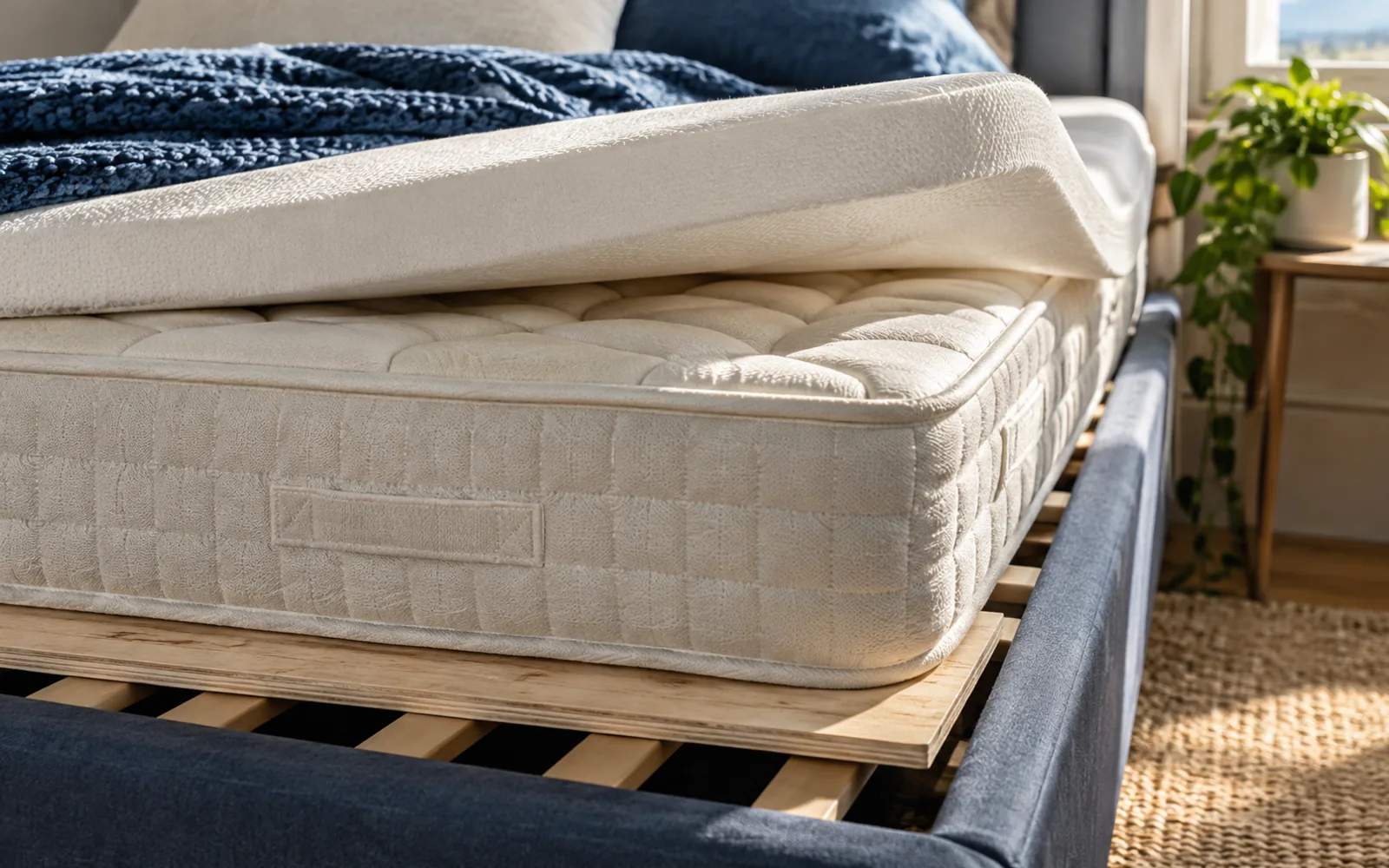
If the foundation is even slightly flexing, a sheet of three-quarter-inch plywood cut to mattress dimensions creates a perfectly rigid base. The mattress no longer compresses into foundation gaps, which firms up the entire feel. This is especially useful for slatted foundations with wider slat spacing. One caveat: some warranties specify approved foundation types, so confirm with the manufacturer before installing if your warranty is still active.
Fix 4: Upgrade the Foundation
A flexing box spring or weak slat system makes any mattress feel softer than it actually is. Replacing the foundation with a rigid solid-top platform or a slat system with one-to-three-inch slat spacing often delivers the most dramatic firmness improvement. This is also a permanent fix that protects mattress warranty terms. Bunkie boards ($80 to $200) are the cheapest version — a thin solid panel that converts an old foundation into a foam-compatible flat base.
Most warranty-voiding sag claims trace back to the foundation, not the mattress.
Read: Mattress Foundations & Support →Fix 5: Lower the Bedroom Temperature
Memory foam in particular softens with heat and firms up when cool. A bedroom that runs in the mid-70s overnight makes traditional viscoelastic foam feel several degrees softer than the same mattress at 65 degrees. The Sleep Foundation's typical sleep-temperature range (65 to 68°F) also happens to be where memory foam feels closest to its rated firmness. Gel and copper-infused foams are less temperature-sensitive but still respond to ambient temperature.
Fix 6: Floor It (Temporary)
Placing the mattress directly on the floor temporarily eliminates any foundation flex and gives the firmest possible support. This is a diagnostic move more than a long-term solution — most warranties require the mattress to be on an approved foundation and floor placement traps heat and moisture underneath. But if floor placement firms it up dramatically, you've confirmed the foundation is your real problem.
When the Mattress Itself Is the Issue
If you've tried a firm topper, a rigid foundation, and a cooler bedroom — and it still feels too soft — the mattress is genuinely too soft for your body. Heavier sleepers (over 230 pounds) compress foam more deeply, which means a mattress rated medium-firm for an average-weight sleeper effectively performs as medium-soft. Replacement with a firmer model in the 7-out-of-10 range or a hybrid with a robust support core is the right move at that point.
The firmness scale is non-standard across brands — our firm mattress rankings normalize across our test set.
Browse Best Firm Mattresses →Not sure where to start?
Take our quick sleep quiz and we'll match you with mattresses that fit your sleep style and budget — no jargon, no upsell.
Find your perfect sleep →