
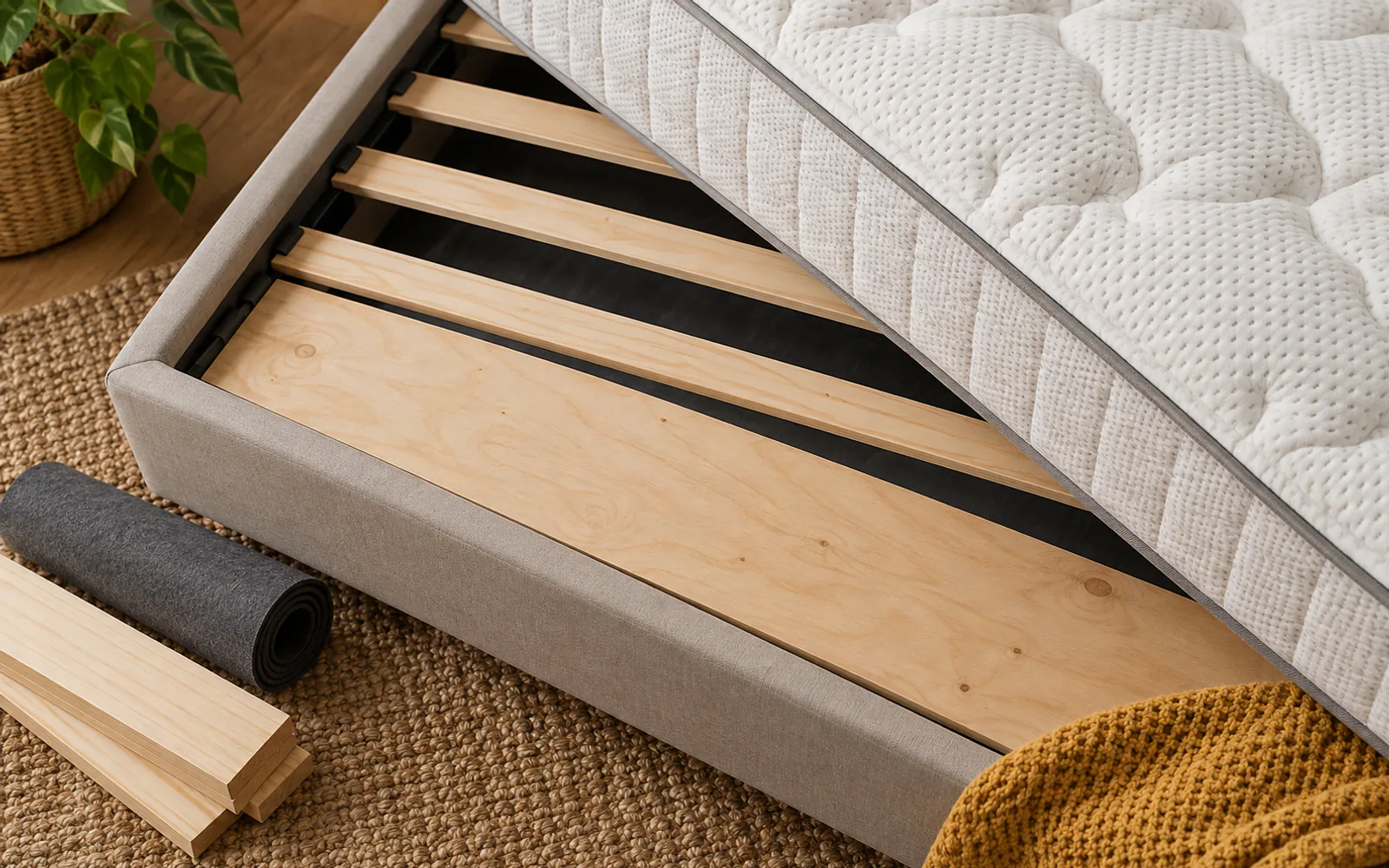
Step 1: Figure Out What's Actually Sagging
Take the mattress off the foundation and lay a yardstick or straightedge across the foundation surface. Look for visible gaps. A foundation that flexes, has missing center support, or has slat spacing wider than three inches is often the real cause of what feels like a mattress sag. If the foundation is flat and rigid, the sag is in the mattress itself.
Quick diagnosis
- Sag follows a body-shape outline → mattress comfort layer has compressed
- Sag runs the full width of the bed → foundation flex or broken center support
- Sag only on one side → uneven foundation legs or worn-out single-side use
- Mattress feels fine off the foundation → the foundation is the problem
Fix 1: Foundation Repairs (Free to ~$200)
If the foundation is the issue, fixing it is the cheapest and most permanent solution. Common foundation problems and the fixes that work:
- Broken or warped slats: replace them. Most platform beds use standard 1×4 pine; a hardware store will cut them to length for under $20.
- Missing center support: a queen or larger mattress needs a center support leg. Add one — universal center-support kits are $30 to $50.
- Slat spacing too wide: if slats are more than three inches apart, slide a bunkie board (a thin solid panel) over the slats. It runs $80 to $200 and instantly creates the firm flat surface most mattresses need.
- Soft or broken box spring: a worn box spring won't recover. Replace it with a low-profile foundation or platform base.
Fix 2: Rotate the Mattress 180 Degrees
If the sag is shallow and confined to one body-shape impression, rotating the mattress so you sleep on the other end gives the compressed area time to recover. This works because the foam recovery process needs the pressure off it. Rotation is also the single most-recommended preventive step — Saatva, Avocado, and Tempur-Pedic all publish rotation schedules in their care documentation. Quarterly in the first year, every six months after that.
If you've never rotated this mattress, that's the first thing to try.
Read: How to Rotate Your Mattress →Fix 3: Add a Firm Mattress Topper
A topper masks surface-level sag and adds new comfort material above the worn comfort layer. It won't restore broken-down support, but it can buy a year or two of useful sleep while you plan for a replacement. A 2- to 3-inch firm latex topper or a high-density polyurethane topper rated at 2.5 pounds per cubic foot or higher delivers the most benefit. Memory foam toppers add comfort but won't address the underlying lack of support.
A topper is a stopgap, not a cure — but a good one buys real time.
Browse Mattress Toppers →Fix 4: Plywood Between Mattress and Foundation
Three-quarter-inch plywood cut to mattress dimensions creates a rigid base that prevents the lower foam layers from flexing into foundation gaps. This is a particularly effective fix when the foundation has minor flex but you don't want to replace it. One important caveat: some mattress warranties specify approved foundation types and plywood can technically violate those terms. Confirm with the manufacturer before installing if your warranty is still active.
Fix 5: File a Warranty Claim
Most major mattress warranties cover body impressions deeper than one to one-and-a-half inches measured from the surrounding surface. Document the sag with a photograph that includes a straightedge laid across it — the visible gap is your evidence. You'll also need your original purchase receipt and proof the mattress was used on an approved foundation. Stained mattresses are usually disqualified, which is why a protector matters.
Warranty claims work when you document them correctly.
Read: Mattress Warranty Guide →When to Replace Instead of Repair
Some signs that a sagging mattress has reached the end of its useful life:
- Sag is deeper than 1.5 inches across a body-sized area
- You wake up with new back, hip, or shoulder pain that didn't exist before
- Mattress is older than seven to eight years, regardless of brand claims
- Coil noise, broken springs visible through the cover, or popping sounds at night
- Foundation is sound and rotation hasn't helped over multiple cycles
At that point, a topper is throwing money at a problem that has a real solution. A new mattress with a proper warranty and trial period is the better investment.
Use the quiz to narrow down replacements that match your sleep position and budget.
Take the Sleep Quiz →Not sure where to start?
Take our quick sleep quiz and we'll match you with mattresses that fit your sleep style and budget — no jargon, no upsell.
Find your perfect sleep →