
What Off-Gassing Is
Off-gassing is the release of volatile organic compounds (VOCs) from a new mattress. These come from foam blowing agents, adhesives that bond layers, and the plastic packaging the mattress shipped in. The compounds are released most intensely in the first 24 to 72 hours after unboxing and taper off over one to four weeks. It's normal, not a defect, and not unique to any particular brand or price tier.
For most healthy adults, the smell is an inconvenience rather than a hazard. People with chemical sensitivities, asthma, or who are pregnant sometimes find the odor uncomfortable enough to want extra ventilation or to sleep elsewhere for the first night or two.
The Habits That Actually Speed It Up
What helps most
- Unbox the mattress in a well-ventilated room — preferably with windows open
- Strip the plastic shipping bag fully and dispose of it outside the room
- Allow the mattress to expand for at least 24 to 48 hours before sleeping on it (and longer is better)
- Run a fan continuously across the surface — moving air dissipates VOCs faster than still air
- Open windows whenever weather allows during the first two weeks
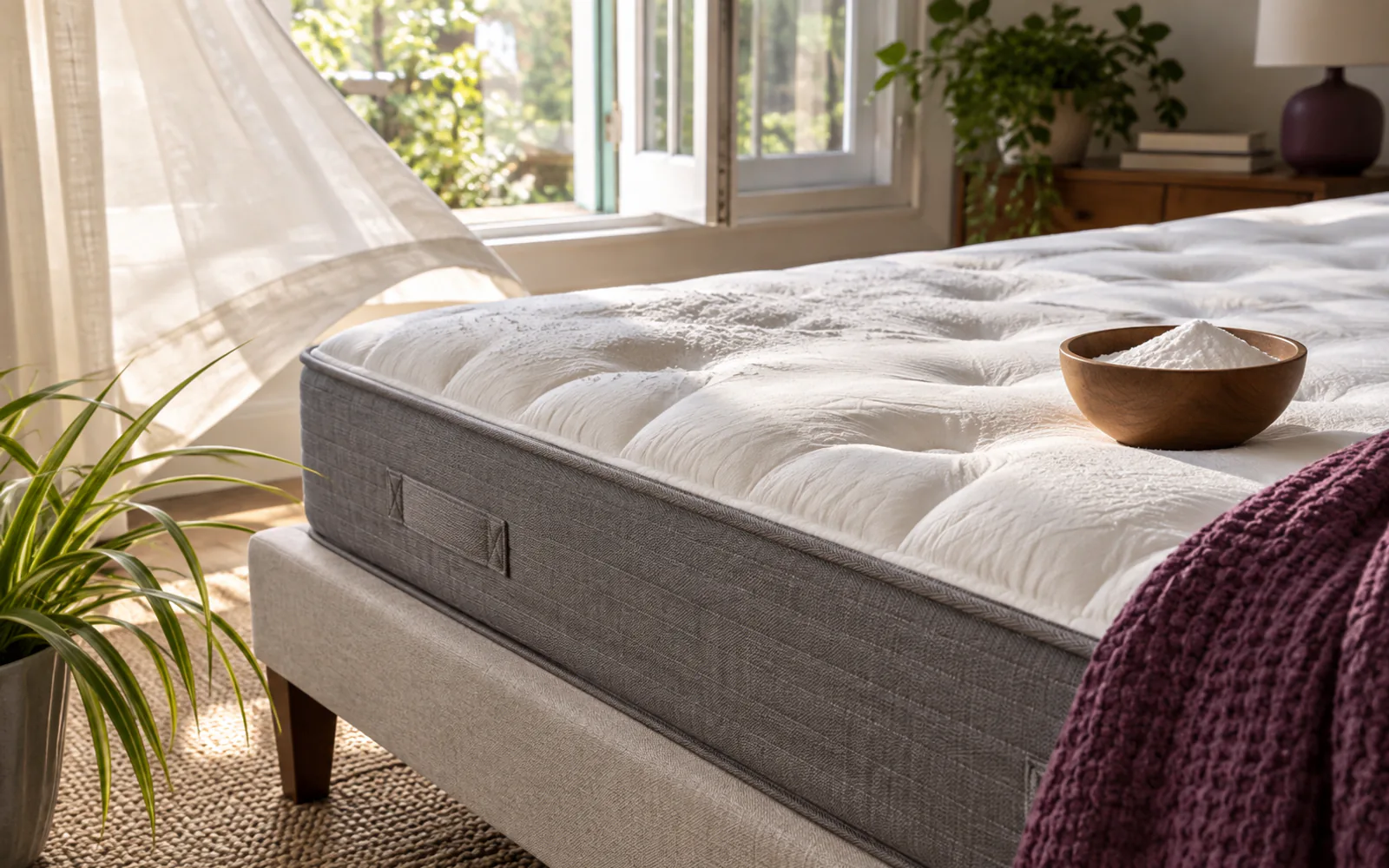
- Sprinkle baking soda over the surface, leave for several hours, then vacuum — absorbs a portion of the surface odor
What Doesn't Really Help
- Air fresheners and scented sprays — they mask odor temporarily without speeding the actual VOC release
- Heat (a hair dryer, space heater near the mattress) — doesn't reliably accelerate the chemistry and can warp foam
- Activated charcoal bags — produce a small effect at best on a surface this large
- Essential oils on the mattress surface — can stain the cover and irritate skin contact later
Type-by-Type: How Long to Expect
Different mattress constructions off-gas at different intensities and durations.
All-foam (memory foam, polyfoam)
Strongest initial odor, longest residual. Plan for 24 to 72 hours of strong smell, then 2 to 4 weeks of mild residual smell in a normally ventilated room. Dense memory foam (4+ lb/ft³) takes the longest.
Hybrid
Moderate. The coil system contributes nothing to off-gassing; the foam comfort layer above it does. Most hybrids clear meaningful smell within a week and have no residual smell by 2 weeks.
Natural latex (Dunlop or Talalay)
Minimal. Natural latex has a faint vanilla-like or rubbery smell that fades within days. Synthetic and blended latex has more odor and a longer dissipation window.
Innerspring with thin foam top
Mild. The bulk of the construction is steel; only the comfort layer contributes off-gassing. Usually clears within a few days.
Certifications That Reduce Off-Gassing
Some certifications cap how strong the off-gassing can be. They don't eliminate odor entirely — even certified foam has a mild new-mattress smell — but they meaningfully reduce the intensity and the chemical inventory:
- CertiPUR-US — for polyurethane foam; limits specific VOC emissions and prohibits certain chemicals (PBDEs, mercury, lead, formaldehyde)
- GREENGUARD Gold — broader product-level emissions standard, including for finished mattresses
- OEKO-TEX Standard 100 — tests for harmful substances in fabrics and treatments
- GOLS (Global Organic Latex Standard) — organic certification specific to latex; lowest off-gassing of common mattress materials
- GOTS (Global Organic Textile Standard) — for cotton and wool components in the cover and quilting
When to Be Concerned vs. Wait It Out
Some signals suggest the smell is normal off-gassing — and others suggest a defect or genuine sensitivity issue.
Normal — wait it out
- Plastic, vinegar-like, or paint-like smell on day one
- Mild residual smell after 1 to 2 weeks of ventilation
- Smell concentrated near the mattress, fading as you walk away from the bedroom
Not normal — contact the brand
Strong smell that hasn't faded after 4 weeks of ventilation, a sweet or rotting smell (suggests a defect in the foam or adhesive), respiratory irritation (cough, headache, throat soreness) that resolves when sleeping in a different room, or visible chemical residue on the cover. Most major brands consider lingering chemical odor a defect and will replace or refund inside the trial period.
If You're Sensitive to Smells
People with asthma, MCS (multiple chemical sensitivity), or pregnancy-related smell sensitivity sometimes find new-mattress off-gassing genuinely difficult. Practical accommodations:
- Unbox in a spare room and let it air for a full week before moving into the bedroom
- Choose natural latex or a GREENGUARD Gold or OEKO-TEX certified mattress for the next purchase
- Sleep on the couch or in another room for the first two to three nights
- Use your trial period — every major DTC brand offers at least 100 nights of return eligibility — if the smell remains intolerable
The trial period exists exactly for problems like this — don't suffer through a smell that won't clear.
Read: How Trial Periods Work →What's in the Air, in Plain Terms
VOCs released from new mattresses include compounds like formaldehyde (in trace amounts, capped by certifications), various alcohols, and small amounts of solvents from adhesives. Independent testing organizations have found that certified mattresses (CertiPUR-US, GREENGUARD Gold) emit VOCs at levels far below indoor air quality concerns once initial off-gassing has passed. If you want to verify a specific product's testing, the brand's product page or customer-service team can provide the third-party certification documentation.
The off-gassing window is also part of the normal break-in for foam feel.
Read: How to Break In a New Mattress →Not sure where to start?
Take our quick sleep quiz and we'll match you with mattresses that fit your sleep style and budget — no jargon, no upsell.
Find your perfect sleep →