
Step 1: Clean Before You Store
Anything you store dirty will be worse when you take it out. Strip the bed, vacuum the entire surface (including seams and the underside), and address any visible stains before wrapping. A baking-soda deodorize over the surface for 30 minutes — then a thorough vacuum — neutralizes accumulated odors that would otherwise concentrate during storage.
A clean mattress comes out of storage in usable shape; a dirty one doesn't.
Read: How to Clean a Mattress →Step 2: Wrap It Breathable, Not Sealed
This is where most storage damage happens. Sealed plastic wrap traps humidity inside the wrap, which means mold and mildew grow on the foam and the cover. The right wrap is breathable:
- Mattress storage bags (available at moving-supply stores for $10 to $30) are vented or made of breathable poly material designed for storage
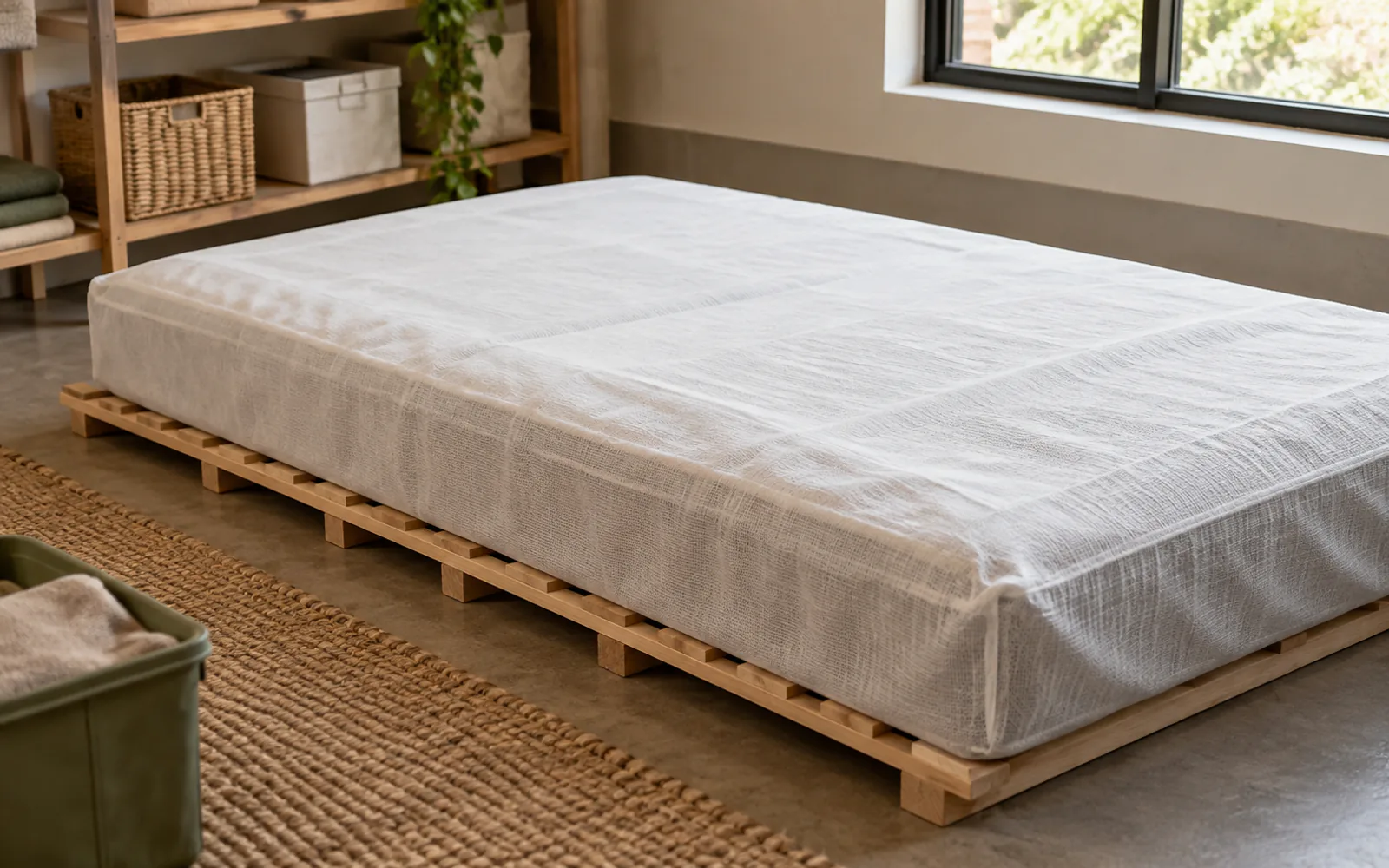
- Reusable cloth mattress covers work well for long-term storage
- Heavy cotton sheets or moving blankets are an acceptable substitute if a proper bag isn't available
- Avoid: regular plastic sheeting, contractor bags, tightly sealed shrink-wrap — anything that traps moisture
If a mattress arrived in a plastic shipping bag
That bag is fine for transport, but should be replaced with a breathable bag for storage longer than a few days.
Step 3: Store It Flat, Not on Its Side
Mattresses are engineered to be supported across their full horizontal surface. Storing them on edge for an extended period — weeks or months — causes uneven compression in foam layers and can warp coil systems. Flat storage is non-negotiable for memory foam and recommended for everything else. If flat storage genuinely isn't possible, rotate the mattress periodically while it's on edge to redistribute compression.
Step 4: Choose Climate-Controlled Storage
Humidity is the single biggest enemy of any stored mattress. Foam absorbs ambient moisture and grows mildew; cotton and wool covers can rot; innerspring coils can develop surface rust in damp environments. Climate-controlled storage units hold steady temperature (typically 55 to 85°F) and humidity (under 50%) — they cost more than basic self-storage but the difference between a usable mattress and a ruined one.
Garages, attics, and unconditioned basements are usually the worst storage locations: temperature swings, humidity, pest access, and possible water exposure. Avoid them unless you have no alternative for less than a few weeks.
Step 5: Elevate the Mattress
Even in a climate-controlled unit, putting the mattress directly on the concrete floor isn't ideal. Place it on a pallet, on top of two-by-four boards, or on a tarp at minimum. Elevation allows airflow underneath and protects against any incidental water on the floor.
How Long Can a Mattress Be Stored?
- Memory foam: up to 6 months in climate-controlled storage without significant degradation
- Hybrid: up to 12 months in climate-controlled storage
- Innerspring: up to 12 months in climate-controlled storage; longer with some risk of coil rust if humidity is high
- Latex (natural): more durable in storage but still benefits from breathable wrap and climate control
These windows assume the mattress was clean going in and the storage conditions stay reasonable. In poor conditions, foam can degrade in weeks. In ideal conditions, a well-prepared mattress can store for considerably longer.
When You Bring the Mattress Back Out
After storage, the mattress needs to acclimate before you sleep on it:
- 1Remove the wrap and inspect the mattress for any visible damage, moisture, or pest activity
- 2Air it out in a well-ventilated room for 24 to 48 hours before re-making the bed
- 3Vacuum the entire surface and the underside to remove storage dust
- 4Sprinkle baking soda over the surface for 30 minutes, then vacuum to neutralize any storage odor
- 5Install a fresh mattress protector before adding sheets
If the mattress was rolled and compressed in storage (rare — only some boxed-in-a-bag mattresses store this way safely), allow 24 to 72 hours for full expansion before evaluating it.
If the storage was part of a move, the moving guide covers truck loading and damage prevention.
Read: How to Move a Mattress →Re-installing a fresh waterproof protector before storage is the cheapest insurance you can buy.
Browse Mattress Protectors →Not sure where to start?
Take our quick sleep quiz and we'll match you with mattresses that fit your sleep style and budget — no jargon, no upsell.
Find your perfect sleep →