Why Sleep Is When You Actually Get Stronger
Exercise doesn't build muscle — it creates the stimulus for muscle to be built. The actual rebuilding happens during sleep, specifically during slow-wave (deep) sleep, when human growth hormone (HGH) is secreted in its highest concentrations. HGH drives muscle protein synthesis, repairs connective tissue, and consolidates the neural pathways that make movement patterns more efficient.
Shortchange this process and you get the signal without the adaptation. You train hard, stay sore longer, and wonder why your performance is plateauing. The research is consistent: sleep-deprived athletes recover slower, perform worse, and get injured more often.
What Happens During Sleep for Athletes
- Deep sleep (stages 3–4): Peak HGH secretion — the primary driver of muscle protein synthesis
- REM sleep: Neural consolidation of movement patterns and motor memory
- All stages: Anti-inflammatory cytokine release reduces exercise-induced inflammation
- Core temperature drop: Initiates sleep onset — key for athletes who run warm post-training
The Performance Costs of Sleep Deprivation
Even one night of poor sleep measurably degrades athletic performance. Multiple nights create compounding deficits that take significantly longer to recover than the debt was accumulated.
- Reaction time: A 17-hour wakefulness period impairs reaction time equivalent to a 0.05% blood alcohol level — the legal limit in most states.
- Muscle recovery: Insufficient sleep blunts the HGH response to training, reducing the adaptation signal by up to 24%.
- Injury risk: Athletes sleeping under 8 hours are 1.7× more likely to sustain a sports injury (Journal of Pediatric Orthopaedics).
- Decision-making: Reduced prefrontal cortex function impairs game-time decisions, play reading, and tactical awareness.
- Cardiovascular efficiency: VO2 max decreases and perceived exertion increases with sleep restriction.
See mattresses matched for athletic recovery — cooling, pressure relief, and support.
Browse mattresses for athletes →What Athletes Actually Need in a Mattress
Athletic bodies put specific demands on a mattress that casual sleepers don't. Sore muscles need pressure relief. Elevated post-workout body temperature needs active cooling. Heavier and more muscular frames need a support core that won't bottom out. Here's how each factor breaks down:
Pressure Relief for Sore Muscles
Delayed onset muscle soreness (DOMS) creates pressure point sensitivity — particularly at the shoulders, hips, and lower back. A mattress that digs into these areas disrupts sleep quality and can extend recovery time. Side-sleeping athletes especially need a comfort layer that cushions without sinking so deep that spinal alignment is lost.
Pressure Relief by Mattress Type
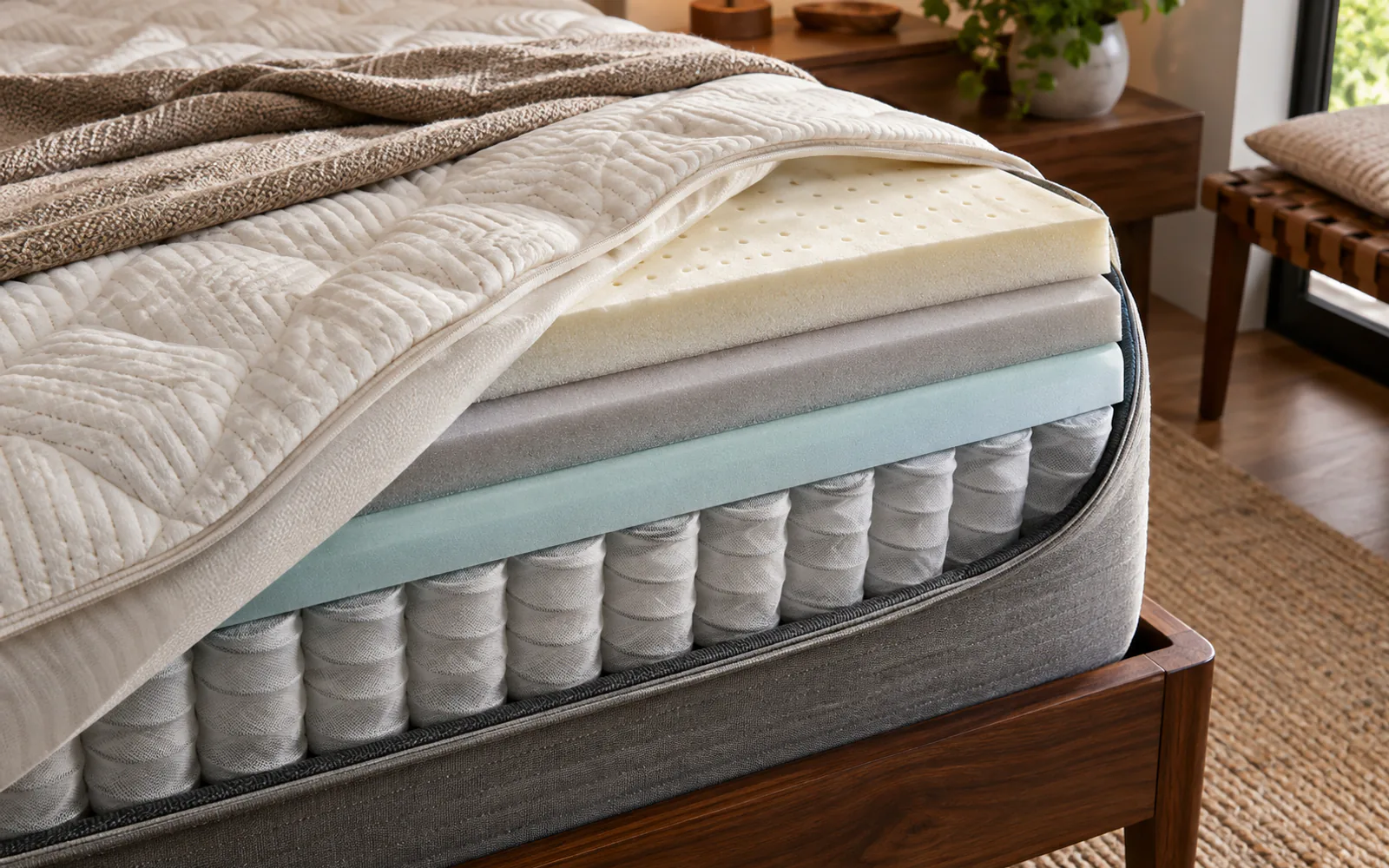
Memory foam: Excellent pressure relief but traps heat. Latex: Good pressure relief with better cooling than foam. Hybrid: Best overall for athletes — combines foam/latex comfort with coil support and improved airflow. Pure innerspring: Poor pressure relief, not recommended for post-training recovery.
Cooling for Elevated Body Temperature
Core body temperature needs to drop 1–2°F for deep sleep to initiate. Athletes often run warmer at night after training — which delays sleep onset and reduces slow-wave sleep depth. A mattress with active cooling features (gel foam layers, copper-infused foam, natural latex, or pocketed coil airflow) accelerates this temperature drop.
Support for Athletic Body Types
Higher muscle mass and body weight require a firmer support core to maintain spinal alignment. A mattress that supports the average sedentary 160-lb person may let a 210-lb athlete sink through the comfort layers into misaligned positioning. Athletes heavier than 200 lbs should prioritize mattresses with high-density foam base layers or reinforced coil systems.
Mattress Features by Athletic Priority
- Muscle soreness → Pressure relief: Look for 'good' or 'excellent' rating
- Post-workout heat → Cooling: Hybrid construction or latex preferred over all-foam
- Heavy/muscular build → Support: High-density base foam or reinforced coil system
- Training load → Motion isolation: Important if you toss/turn during recovery nights
- Long-term investment → Durability: Latex and quality hybrids outperform cheap foam
Sleep Hygiene Strategies for Athletes
The mattress is the foundation, but sleep hygiene determines whether you actually get the recovery hours your mattress is equipped to support.
- Train timing: High-intensity training within 3 hours of bedtime raises cortisol and core temperature, delaying sleep onset. Schedule hard sessions in the morning or early afternoon when possible.
- Pre-sleep nutrition: A small protein-rich snack (20–40g casein protein) before bed provides sustained amino acid availability for overnight muscle protein synthesis.
- Temperature: Set the bedroom to 65–68°F. Combined with a cooling mattress, this creates the thermal environment most conducive to deep sleep.
- Consistent schedule: Sleep timing consistency matters as much as duration. Irregular schedules disrupt circadian rhythm and reduce slow-wave sleep efficiency.
- Light management: Blue light exposure within 90 minutes of bed suppresses melatonin. Use night mode or amber glasses after sunset during training seasons.
Performance Bedding: The Rest of the Recovery Stack
The mattress is the biggest variable, but the full bedding stack matters for athletes who prioritize sleep quality. Moisture-wicking sheets pull sweat away from the sleep surface. Temperature-regulating toppers can extend the life of an older mattress while improving cooling. For athletes with significant temperature regulation needs, systems like Eight Sleep or ChiliSleep provide active thermal control.
See our full guide to cooling sheets, moisture-wicking protectors, and sleep tech for athletes.
Performance Bedding Guide →Top Mattress Features to Look For
Athlete Mattress Checklist
- ✓ Cooling rating: Good or Excellent
- ✓ Pressure relief: Good or Excellent
- ✓ Mattress type: Hybrid or Latex (preferred over all-foam for airflow)
- ✓ Trial period: 100+ nights to evaluate during an actual training cycle
- ✓ Firmness: Medium-firm (6–7/10) for most; medium (5–6) for side-sleeping athletes with joint soreness
- ✓ Durability: High-density foam base (1.8+ lb density) or quality pocketed coil system
Take our quiz — it factors in sleep position, body type, cooling needs, and budget.
Find your recovery mattress →Not sure where to start?
Take our quick sleep quiz and we'll match you with mattresses that fit your sleep style and budget — no jargon, no upsell.
Find your perfect sleep →