
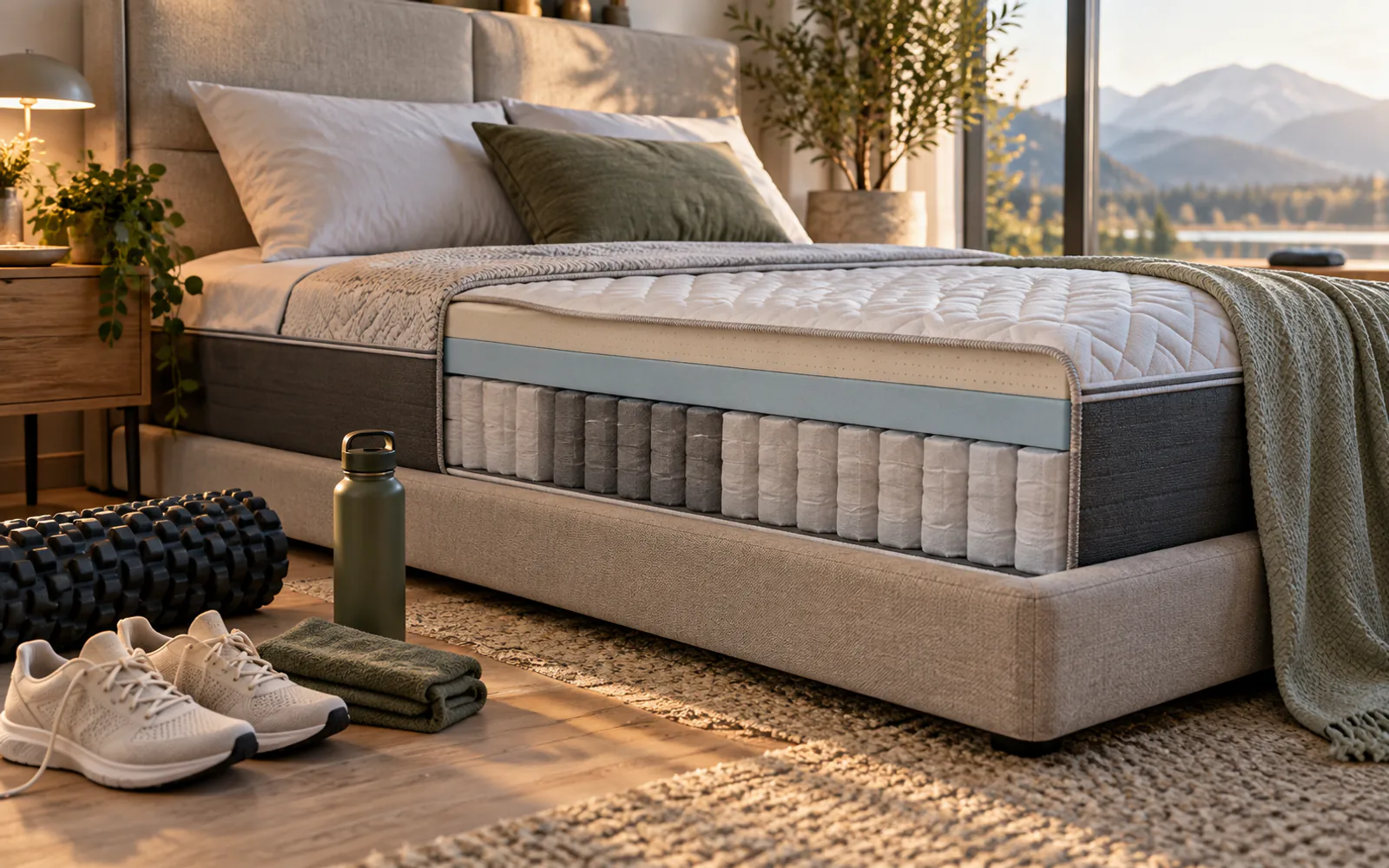
What Actually Happens During Sleep Recovery
Physical recovery during sleep happens through several concurrent processes, each tied to specific sleep stages:
- Tissue repair: Growth hormone is released primarily during slow-wave (deep) sleep. This triggers protein synthesis and muscle repair. Anything that fragments deep sleep — including pain from pressure points — reduces this window.
- Glymphatic system clearance: During sleep (especially deep sleep), the brain's glymphatic system expands, flushing metabolic waste including beta-amyloid and tau proteins. This process is positively affected by sleep position and duration.
- Inflammatory regulation: Sleep deprivation elevates inflammatory markers (IL-6, TNF-α, CRP). Chronic inflammation is the mechanism through which poor sleep accelerates injury risk and slows recovery.
- Motor memory consolidation: Skill learning and motor pattern refinement happens during REM sleep. Athletes who sleep more after practice retain and automate motor skills faster.
How Pressure Points Disrupt Recovery
When a mattress doesn't adequately support your body's natural curves, high-pressure zones develop at the shoulder, hip, and lower back. These pressure points do two things that directly impair recovery:
- They trigger micro-arousals. The nervous system detects discomfort and initiates position changes, often waking you partially or fully. Even if you don't remember waking, these arousals fragment sleep architecture — reducing total deep sleep time.
- They activate the pain response. Sustained pressure activates nociceptors (pain receptors), which elevate sympathetic nervous system activity. Elevated sympathetic tone suppresses the parasympathetic state needed for deep recovery sleep.
What This Means for Mattress Selection
- ✓Side sleepers need a mattress that relieves the shoulder and hip — typically medium-soft (4–5/10) to medium (5–6/10) to avoid creating pressure point-induced arousals
- ✓Back sleepers need lumbar support that prevents the lower back from sagging — medium-firm (6–7/10) is typically optimal
- ✓Stomach sleepers need enough firmness to keep the pelvis from sinking and hyperextending the lumbar spine
- ✓Heavy sleepers need higher-density materials that don't compress fully under greater body mass
Temperature and Recovery
Core body temperature naturally decreases during sleep, reaching its nadir during the deepest recovery stages. A mattress that traps heat (particularly dense memory foam) can prevent this drop, reducing the depth and duration of restorative sleep.
For athletes or anyone with active inflammation, this is particularly important. An elevated sleep temperature reduces the duration of stage 3 deep sleep, which is precisely when growth hormone release and tissue repair peak. Breathable materials (latex, hybrid coil systems, open-cell foams) perform meaningfully better in this dimension than traditional dense memory foam.
Motion Isolation and Sleep Partner Effects
Couples sharing a bed face a compounding recovery challenge: a partner's movements during sleep create micro-arousals throughout the night. A mattress with poor motion isolation (traditional innerspring, very firm foam) amplifies these disturbances. Pocket coil hybrids and memory foam absorb movement at the source, significantly reducing partner-induced arousals.
Mattress Age and Its Effect on Recovery
A 2009 Oklahoma State University study had participants sleep on their existing mattresses for 28 days, then on new medium-firm mattresses for 28 days. The new mattress group showed a significant reduction in back pain, shoulder pain, and morning stiffness — and improved sleep quality scores. The average age of the replaced mattresses was 9.5 years.
Mattress materials compress and degrade over time. A mattress that provided optimal pressure relief at year one may be creating pressure points by year eight. If you've been sleeping on the same mattress for 7+ years and notice increased morning stiffness, fatigue, or reduced recovery between workouts, the mattress is a high-probability contributor.
Signs Your Mattress Is Affecting Your Recovery
- ✓You wake up stiffer than when you went to bed
- ✓Your sleep quality feels better at hotels than at home
- ✓You're aware of the bed moving when a partner repositions
- ✓You wake up with localized shoulder, hip, or lower back pain that resolves within an hour
- ✓You feel unrested despite adequate time in bed
Ready to upgrade your sleep surface?
The mattress you sleep on directly affects your sleep quality. Use our 2-minute quiz to find one matched to your sleep style, body, and budget.
Find my perfect sleep →