
Why Hip Pain Gets Worse on the Wrong Mattress
Greater trochanteric bursitis — inflammation of the fluid-filled bursa sac over the outer hip — is a direct pressure problem. When you sleep on your side, the full lateral load of your body concentrates on the greater trochanter, a bony prominence roughly the size of a golf ball. A firm mattress surface provides no relief: the bone presses against an unyielding surface for 6–8 hours, producing mechanical compression that inflames the bursa and aggravates surrounding gluteal tendons. Hip replacement patients face similar risks, with the added concern that insufficient hip cushioning can create discomfort at the surgical site and disturb the healing process.
The too-firm problem: direct bursa compression
On a too-firm mattress, the greater trochanter bears concentrated mechanical load rather than distributing it. The ideal hip sinkage for a side sleeper is approximately 1–2 inches below the mattress plane — enough to spread the contact area from a single point (the bony prominence) across a wider zone of soft tissue. A firm surface prevents this sinkage, maintaining a narrow pressure point over the bursa for the entire night. Over weeks of this pattern, even mild underlying bursitis can escalate to chronic inflammation. For people who already have bursitis, this nightly compression is often the dominant driver of daytime pain.
The too-soft problem: pelvic drop and IT band tension
A mattress that is too soft creates a different mechanical failure. When the hip — the heaviest part of the side-sleeping body — sinks more than 2–3 inches, the pelvis drops below the shoulder line. This lateral tilt stretches the iliotibial (IT) band along the outer thigh, loads the gluteal tendons asymmetrically, and compresses the bursae on the downward-facing hip. The resulting pain presents at the same outer hip location as bursitis from a too-firm surface, making it difficult to diagnose without understanding the underlying biomechanics. This is why the approach of simply getting something soft often fails hip pain sufferers: extreme softness can worsen, not improve, lateral hip pain.
Ideal Firmness Range for Hip Pain Side Sleepers
- Optimal range: Medium-soft to medium (4–6/10 on the firmness scale)
- Soft enough to allow 1–2 inches of hip sinkage and relieve trochanteric bursa pressure
- Firm enough to prevent pelvic drop and lateral IT band tension
- If you weigh 200+ lbs: bias toward medium (5.5–6/10) — foam compresses further under higher body weight, increasing effective hip sinkage
- If you weigh under 130 lbs: bias toward medium-soft (4–4.5/10) — lighter bodies need a softer surface to achieve adequate hip relief
- Hip replacement patients: confirm firmness with your orthopedic surgeon — post-surgical guidance may specify a different surface depending on surgical approach
Why comfort layer depth matters as much as firmness
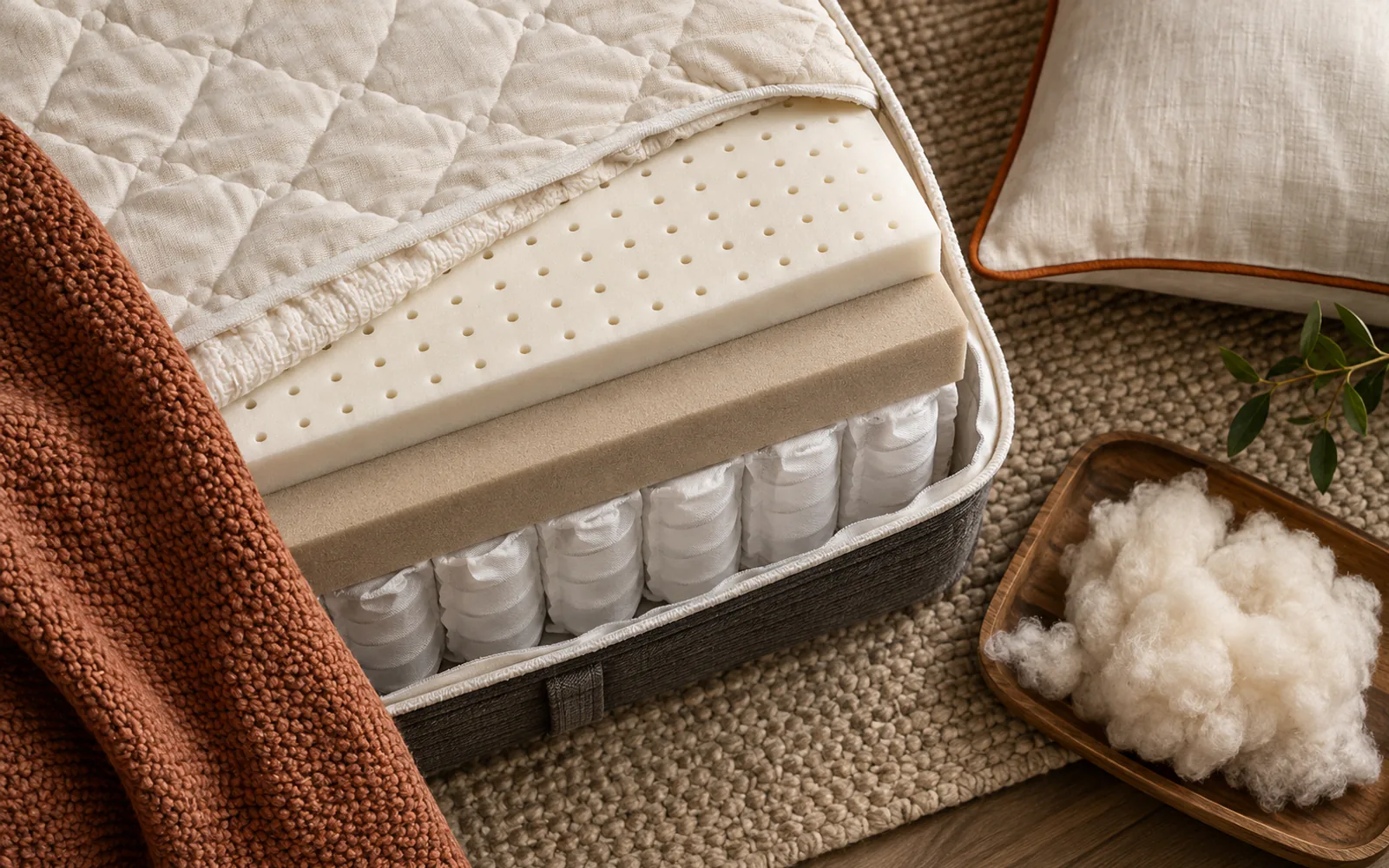
Firmness is only half the equation. A mattress labeled medium-soft with a 1.5-inch comfort layer will still bottom out under hip pressure — the hip will compress through the comfort layer and hit the denser support foam below, creating the same concentrated pressure point as a firm surface. For adequate hip relief, the pressure-distributing comfort layer needs to be at least 3 inches deep, with sufficient density (3.5+ PCF for memory foam, ILD 19–24 for latex) to hold its shape over the night without collapsing.
Zoned support: why the shoulder and hip need different responses
The shoulder and hip are at different heights on the side-sleeping body and need different support responses. A uniform-firmness mattress forces a compromise: soft enough for the hip means too soft for shoulder alignment, or firm enough for the shoulder means too firm for hip pressure relief. Zoned support systems — with a softer zone under the shoulder and progressively firmer coils or foam through the lumbar and hip zone — allow each area to respond appropriately. For hip pain sufferers, zoned construction provides a meaningful advantage over uniform-firmness alternatives, particularly in the hybrid category.

Our Picks: Best Mattresses for Hip Pain Side Sleepers
The three mattresses below were selected against a hip pain side sleeper criteria checklist: medium-soft to medium firmness (4–6/10), sufficient comfort layer depth (3+ inches) for hip pressure distribution, meaningful pressure relief at the greater trochanter without pelvic drop, and adequate trial period to evaluate bursitis symptom change. Each is a real product at a verified price point.
Budget Pick: Nectar Original (~$799 Queen)
- Medium firmness (5/10) sits in the appropriate range for most hip pain side sleepers under 180 lbs — soft enough for meaningful hip sinkage while maintaining pelvic alignment
- 3-inch gel memory foam comfort layer provides the depth needed to distribute hip pressure across a wider contact area, reducing peak load on the greater trochanter; the gel infusion helps manage the localized heat buildup that occurs when one hip is compressed against the surface for hours
- 5-inch high-density base foam (2.2 PCF) supports the comfort layer without creating a bottoming-out effect — the hip sinks into the comfort layer and is held there, rather than compressing through to a hard floor
- TENCEL cover is moisture-wicking, important for side sleepers who generate localized heat and moisture at the compressed hip contact point over a full night
- 365-night trial and lifetime warranty give bursitis sufferers the time needed to evaluate whether a surface change is genuinely reducing inflammation — more meaningful than the industry-standard 100-night trial for a condition that takes 4–8 weeks to show measurable response
Performance Pick: Helix Midnight Luxe (~$1,699 Queen)
- Zoned lumbar support system is the defining structural advantage: the pocketed coil layer is softer under the shoulder zone and progressively firmer through the hip zone, allowing the shoulder to cushion into the mattress while maintaining enough hip support to prevent pelvic drop — the precise mechanical profile hip pain side sleepers need
- 2-inch memory foam comfort layer plus 1-inch transition foam provides 3 total inches of pressure-distributing material over the coil system, sufficient to relieve the greater trochanter without allowing the pelvis to sink past the point of iliotibial band tension
- Pocketed coil base responds independently at each coil, meaning hip pressure does not create a wave displacement effect through the mattress that disturbs spinal alignment — each zone flexes in proportion to the load above it
- Medium firmness (6/10) is toward the firmer end of the hip pain range, making this the stronger choice for side sleepers between 160 and 230 lbs — heavier bodies compress foam further, so starting from a firmer baseline achieves the same effective sinkage as a softer mattress under lighter body weight
- Phase-change material cover actively manages surface temperature, reducing the heat accumulation at the compressed hip that can increase local inflammation and tissue sensitivity overnight
Premium Pick: Saatva Classic Plush Soft (~$2,179 Queen)
- Plush Soft firmness (3/10) provides the deepest hip cushioning of the three picks — individually wrapped Lumaflex coils allow the hip to sink into the mattress while the Euro pillow top distributes pressure across the broadest possible contact surface, minimizing peak load on the greater trochanter
- Dual coil system (individually wrapped comfort coils over a tempered steel Bonnell base) provides progressive support: the comfort coils yield to hip pressure in the top layer while the base coil system prevents the pelvis from sinking past the critical pelvic alignment threshold — a design that resolves the too-soft problem inherent in single-layer plush mattresses
- Euro pillow top (2.5 inches of premium foam and fiber layers) adds surface softness without compromising the structural support beneath — hip sinkage is absorbed by the pillow top rather than by collapsing the coil system, maintaining lateral spinal alignment
- Lumbar Zone technology reinforces the center third of the mattress with a denser wire gauge and additional support bars, providing extra resistance against pelvic drop at the hip zone without firming the shoulder zone — effective passive zoning
- 365-night trial and lifetime warranty match Nectar coverage at a higher price point — justified by the dual coil construction, superior durability, and Saatva's established track record on warranty claims
Comparison at a Glance
Nectar Original — Budget
- Price (Queen): ~$799
- Type: All-foam
- Firmness: Medium (5/10)
- Cooling: Good (gel foam + TENCEL cover)
- Pressure Relief: Very Good
- Zoned Support: No
- Best for: Hip pain side sleepers under 180 lbs seeking deep pressure relief on a budget, and those who need the longest possible trial period
Helix Midnight Luxe — Performance
- Price (Queen): ~$1,699
- Type: Hybrid (foam + pocketed coils)
- Firmness: Medium (6/10)
- Cooling: Very Good (coil airflow + phase-change cover)
- Pressure Relief: Excellent
- Zoned Support: Yes — softer at shoulders, firmer at lumbar/hip
- Best for: Hip pain side sleepers 160–230 lbs who want zoned coil support and hybrid responsiveness alongside pressure relief
Saatva Classic Plush Soft — Premium
- Price (Queen): ~$2,179
- Type: Innerspring hybrid (dual coil system + Euro pillow top)
- Firmness: Plush Soft (3/10)
- Cooling: Excellent (coil airflow + breathable organic cotton cover)
- Pressure Relief: Excellent
- Zoned Support: Yes — Lumbar Zone center reinforcement
- Best for: Hip pain side sleepers under 200 lbs who want maximum hip cushioning with durable dual-coil support, or post-hip-surgery patients cleared for a plush surface
💡 Prices change frequently. Click any mattress above to see today's deal.
Ready to buy? Click any mattress above to see today's price.
Compare Head-to-Head
Still deciding? Take our quick mattress quiz to get personalized recommendations based on your specific needs.
Find Your Perfect Match →Getting More Than Just the Mattress Right: Sleep Position and Hip Pain
A better mattress addresses the most important mechanical factor in nighttime hip pain. But the mattress surface alone is not always sufficient, especially for people with established bursitis. These complementary interventions work alongside a good sleep surface:
- Knee pillow between the legs: Keeps the hips and pelvis in neutral lateral alignment, reducing the twisting load on the iliotibial band and preventing internal hip rotation that compresses the trochanteric bursa — effective immediately on night one
- Sleep on the pain-free side: If bursitis affects one hip more than the other, sleeping with the healthy hip down reduces direct bursa compression on the affected side; the mattress should still be soft enough to cushion the downward shoulder appropriately
- Hip position during sleep: Avoid the fetal position (knees pulled tightly toward the chest) — this posture flexes the hip past 90 degrees, which can increase lateral hip tension and bursa irritation; a gentle bend (30–45 degrees at the knee) is preferable
- Morning tracking: Note your hip pain level (1–10) each morning during the mattress trial — bursitis symptoms should trend downward over 3–6 weeks on a properly soft surface; stagnant or worsening pain at week 4 or beyond suggests a firmness mismatch
Not sure which pick suits your body weight and hip pain severity? Take our 90-second quiz.
Find your match →What to Look For If None of These Fit Your Budget
If your budget falls outside the options above, these are the non-negotiable specifications to evaluate on any mattress for hip pain side sleeping:
- Firmness: Medium-soft to medium (4–6/10) — the most important single variable; do not compromise on this range regardless of price point
- Comfort layer depth: Minimum 3 inches of pressure-distributing foam or latex above the support core; below this threshold, the hip bottoms out and the benefit of softer foam disappears
- Comfort layer density: Memory foam should be 3.5+ PCF; generic polyfoam should be 1.8+ PCF — ask the brand directly if not listed; low-density foam collapses over weeks and stops providing pressure relief
- Trial period: 90 nights minimum — hip bursitis takes 4–8 weeks to show measurable response to surface changes; 30-night trials are insufficient for this condition
- Avoid spring systems without adequate comfort layers: A traditional innerspring with only 1 inch of padding will not provide sufficient hip pressure relief at any firmness rating
Browse our full mattress database — filter by firmness, type, and price to find hip-pain-appropriate options.
Browse all mattresses →Trial Periods, Warranties, and Our Transparency Commitment
All three picks above offer at minimum a 100-night trial with free returns. Nectar and Saatva both offer 365 nights. We recommend hip pain sufferers use the full trial period — bursitis inflammation takes weeks to respond to surface changes, and you need enough time to confirm whether a mattress is genuinely helping rather than just feeling different.
Our Research Commitment
- We do not accept payment for guide placements — picks are based on specifications and fit to the stated use case
- We earn affiliate commissions on purchases, which supports our ability to maintain this database — this does not influence which products appear or their ranking
- Mattress prices fluctuate — the prices cited above reflect approximate queen prices at time of publication; check the retailer for current pricing
- We update guides when products, pricing, or availability change significantly
Not sure where to start?
Take our quick sleep quiz and we'll match you with mattresses that fit your sleep style and budget — no jargon, no upsell.
Find your perfect sleep →