
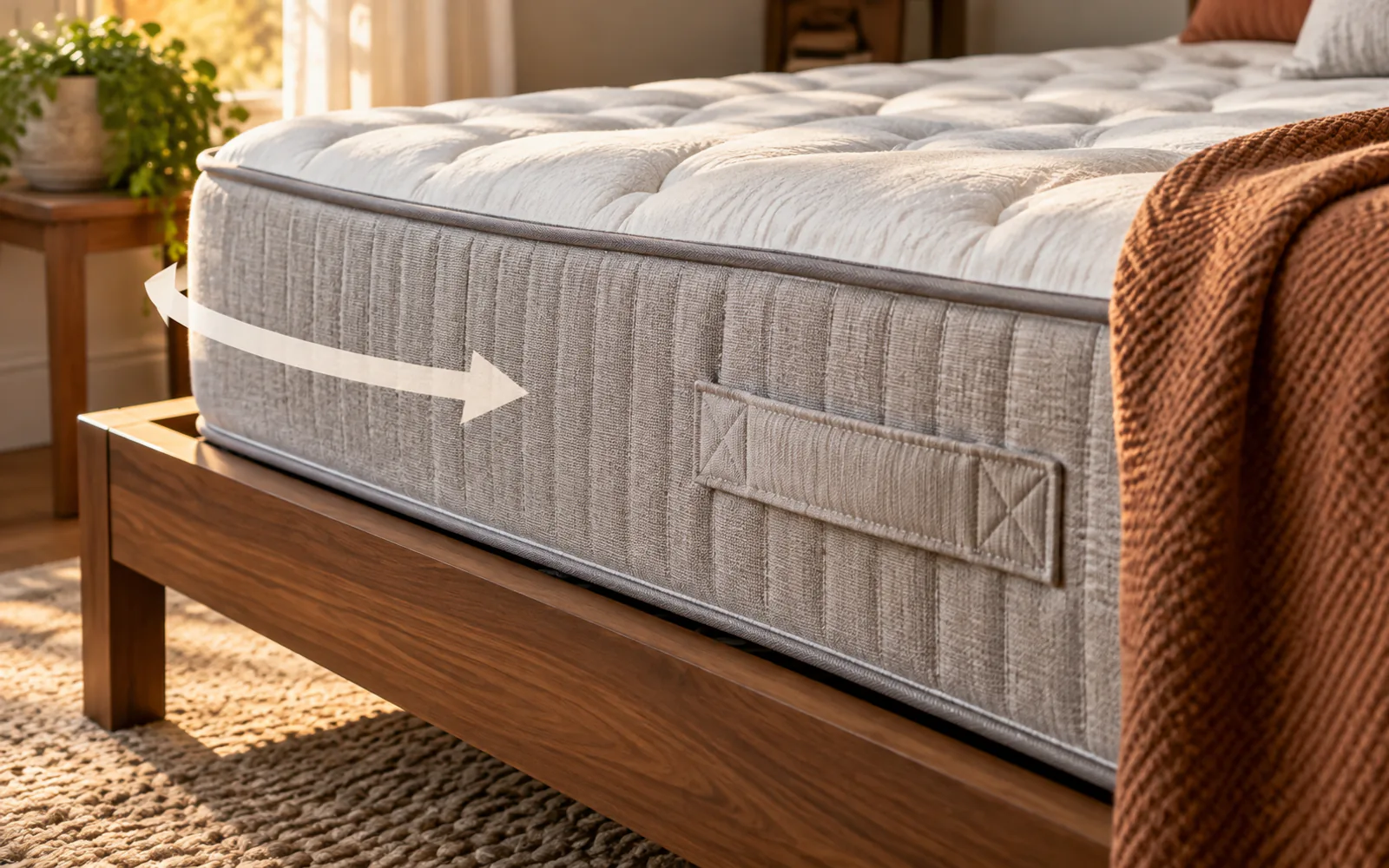
Flip vs. Rotate: The Key Difference
Rotating means turning the mattress 180 degrees on the horizontal plane — the head of the mattress becomes the foot. The sleep surface still faces up. Flipping means turning the mattress over so the bottom becomes the new sleep surface. These are two completely different operations with different implications.
The short answer
Rotate every three to six months. Don't flip unless the manufacturer specifically labels the mattress as flippable. Almost every memory foam, hybrid, pillow-top, and zoned mattress sold today is single-sided and not designed to be flipped.
Why Modern Mattresses Aren't Flippable
Most contemporary mattresses are built with intentional layer ordering: a softer comfort layer on top, a transition layer in the middle, and a firm support core at the bottom. Flipping puts the firm core on top, which feels harsh and doesn't deliver the pressure relief the design was engineered for. The cover quilting is also usually one-sided — flipping puts the decorative/breathable side against the foundation, where it does nothing.
A small number of mattresses are still designed as flippable — dual-firmness flippable mattresses (one side soft, one side firm) and traditional double-sided innerspring or latex constructions. The product page or care guide will say so explicitly. If it doesn't say flippable, assume it isn't.
How Often to Rotate
The general rule:
- First year: every three months (the mattress is breaking in and uneven wear shows up faster)
- Years two through five: every six months
- Years five and beyond: every six months, or whenever you notice a body impression developing
Many manufacturers print rotation cadences directly on the law tag or in the warranty booklet. Saatva, Tempur-Pedic, and Avocado all publish recommended rotation schedules on their care pages. Following the brand's specific schedule is the safest move for warranty validity.
Rotation by Mattress Type
Memory foam
Rotate, never flip. All-foam construction is single-sided and the support core is firmer than the comfort layer. Rotate every three to six months.
Hybrid
Rotate, never flip. The pocketed coil core is below the comfort layer for a reason — flipping puts the coil layer on top, which is uncomfortable and can damage the construction.
Innerspring (modern, pillow-top)
Rotate, never flip. Modern pillow-tops are quilted on one side only. Flipping puts the firm core upright and the pillow-top facing the foundation.
Innerspring (traditional, two-sided)
Some traditional innersprings are flippable. Check the law tag or manufacturer guidance. If flippable, alternate between flipping and rotating each cycle.
Latex (single-sided)
Rotate, never flip. Most modern latex mattresses are single-sided with a comfort layer over a firmer support core.
Latex (dual-firmness flippable)
Flip when you want to change the feel — many natural latex mattresses are sold as flippable with a softer side and firmer side. Use the side that suits the season or sleep position.
How to Physically Rotate a Mattress
A queen or larger mattress is a two-person job. The technique:
- 1Strip the bed of all sheets, the protector, and any topper
- 2Stand on opposite long sides of the mattress, one person at the foot and one at the head
- 3Lift the mattress off the foundation (just enough to clear)
- 4Walk it 180 degrees together — what was at the head is now at the foot
- 5Set it back on the foundation, aligned with the frame
- 6Vacuum both the mattress and the foundation while you have access — most people only see the underside during this rotation
- 7Re-make the bed
Make rotation easier
Mark one corner of the mattress with a small piece of tape labeled with the rotation date. Move it each time you rotate. After a year of doing this you'll have a consistent record of when you last rotated — and it makes warranty documentation easier if you ever need to file a claim.
When Not to Rotate
A small number of mattresses shouldn't be rotated:
- Zoned constructions where the support is firmer in the lumbar zone — rotating moves the zoning to the wrong position (Helix Midnight Luxe and similar zoned hybrids fall in this category; check the care guide)
- Mattresses with a clearly marked head and foot (some adjustable-base-compatible mattresses)
- Toppers integrated into the mattress in a directional pattern
When in doubt, the manufacturer's care page is the authoritative answer.
If rotation isn't fixing a developing dip, it's time to look at other options.
Read: How to Fix a Sagging Mattress →Rotation is the moment to re-install a fresh protector — it's the single biggest thing that extends mattress life.
Browse Mattress Protectors →Not sure where to start?
Take our quick sleep quiz and we'll match you with mattresses that fit your sleep style and budget — no jargon, no upsell.
Find your perfect sleep →