
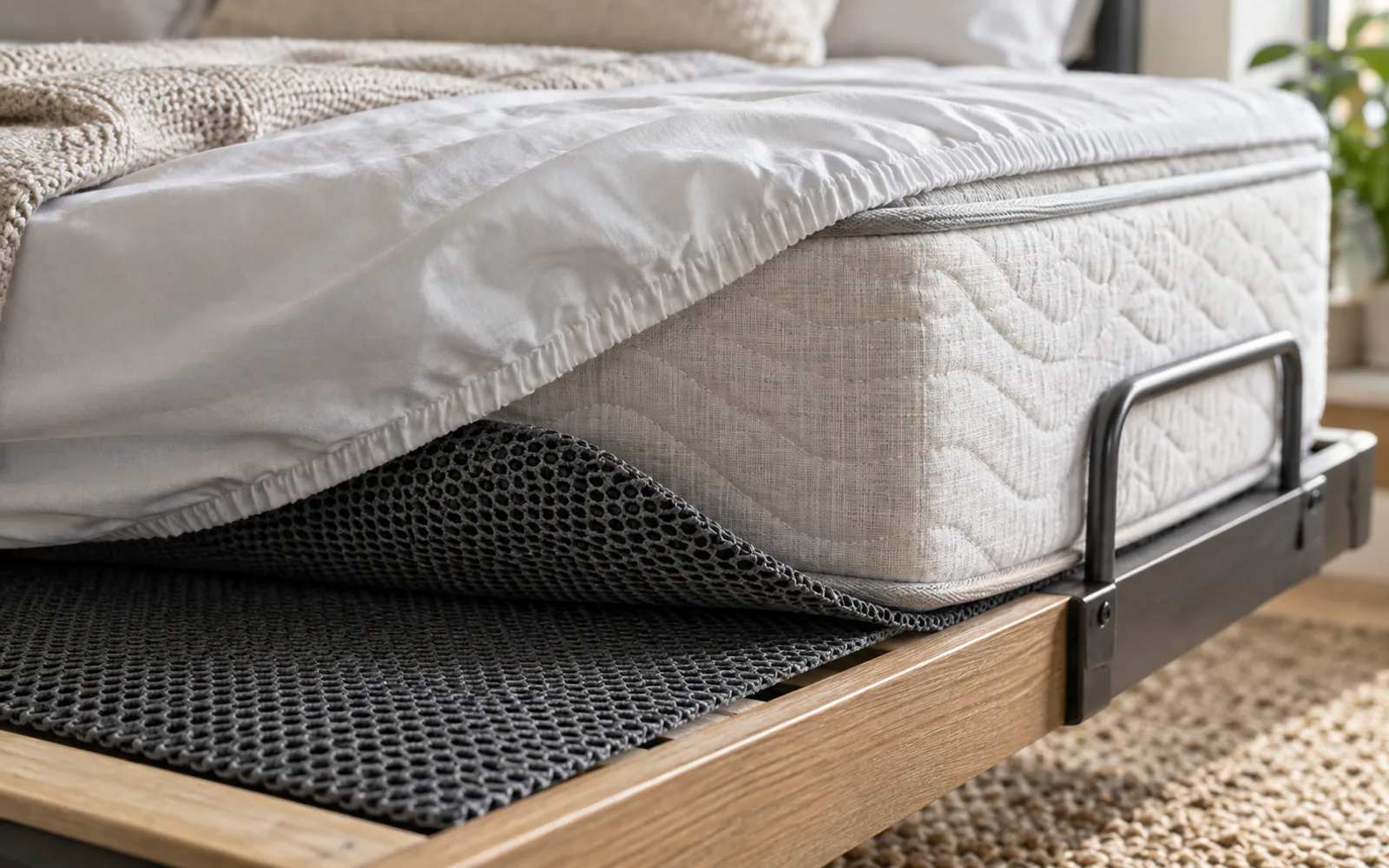
Why Mattresses Slide
Three common causes:
- Smooth foundation surface — metal platforms, polished wood, some adjustable bases have low surface friction and don't grip the mattress underside
- Wide slat spacing — if slats are more than three inches apart, the mattress's bottom layer doesn't have consistent support and rocks slightly with every movement, slowly migrating
- Tight fitted sheets — sheets that are too small for the mattress depth pull at corners as the sleeper moves, incrementally walking the mattress across the foundation
- No retainer bar or footboard — without a physical barrier, gradual sliding has nothing to stop it
Fix 1: Non-Slip Grip Mat
The simplest and most universal fix. A rubberized or PVC grip mat between the mattress and foundation increases friction enough to stop almost all sliding. They're sold specifically for this purpose (search "mattress non-slip pad") or you can use heavy-duty rug grip pads cut to mattress dimensions. Cost: $15 to $40. Installation: lay the mat across the foundation, place the mattress on top, done.
Why this works
Most sliding is a friction problem, not a structural one. The grip mat's textured rubber surface bonds with both the mattress underside and the foundation top, creating enough static friction to lock the mattress in place.
Fix 2: Industrial Velcro Strips
For platform beds with smooth wood or metal surfaces where a grip mat slides on its own, industrial-strength Velcro (the heavy-duty kind sold for outdoor use, not standard craft Velcro) creates a physical bond. The hook side adheres to the foundation, the loop side to the mattress underside. Place strips at all four corners and one or two along each long edge.
Two caveats: the adhesive can leave residue when removed, and applying anything to the mattress underside can technically violate warranty terms. Confirm before installing if your warranty is still active. For most older mattresses or post-warranty beds, Velcro is the most reliable permanent fix.
Fix 3: Bed Frame With Retainer Bar or Footboard
Many platform beds and adjustable bases include a retainer bar at the foot of the bed that physically blocks the mattress from sliding. Footboards do the same job, as does a side-rail lip. If sliding is a recurring problem with your current setup and you're shopping for a new bed frame anyway, prioritize frames with built-in retention. This is the most permanent fix because it doesn't depend on friction at all.
Fix 4: Address the Slat Spacing
If the foundation is slatted with gaps wider than three inches, the mattress doesn't have consistent support and small movements at the gap edges add up over time. A bunkie board ($80 to $200) — a thin solid panel laid across the slats — converts the slatted base into a flat surface that grips the mattress more uniformly. This also extends mattress life by preventing the comfort layer from compressing into the slat gaps.
If the foundation is the underlying issue, fix that and several other small problems disappear with it.
Read: Mattress Foundations & Support →Fix 5: Right-Size Your Fitted Sheets
Sheets that are too small for the mattress depth pull at the corners every time someone shifts, gradually working the mattress across the foundation. Most modern mattresses are 12 to 14 inches deep — a sheet rated for 9- to 12-inch depth will pull tight every night. Check the depth rating on the sheet packaging and match it to your mattress thickness. Deep-pocket sheets sized for 14- to 18-inch mattresses sit loosely enough that they don't tug.
When the Mattress Is the Issue
Occasionally the mattress itself contributes to sliding — an older mattress with a worn underside cover loses traction, and some mattresses ship with slick non-grip backings. In these cases, the grip mat fix (Fix 1) usually resolves it. If sliding is severe and pairs with sagging or other wear, the mattress is reaching end of life and the sliding is a symptom rather than the core problem.
Other late-life mattress symptoms — sagging, lost edge support — are covered separately.
Read: How to Fix a Sagging Mattress →Not sure where to start?
Take our quick sleep quiz and we'll match you with mattresses that fit your sleep style and budget — no jargon, no upsell.
Find your perfect sleep →