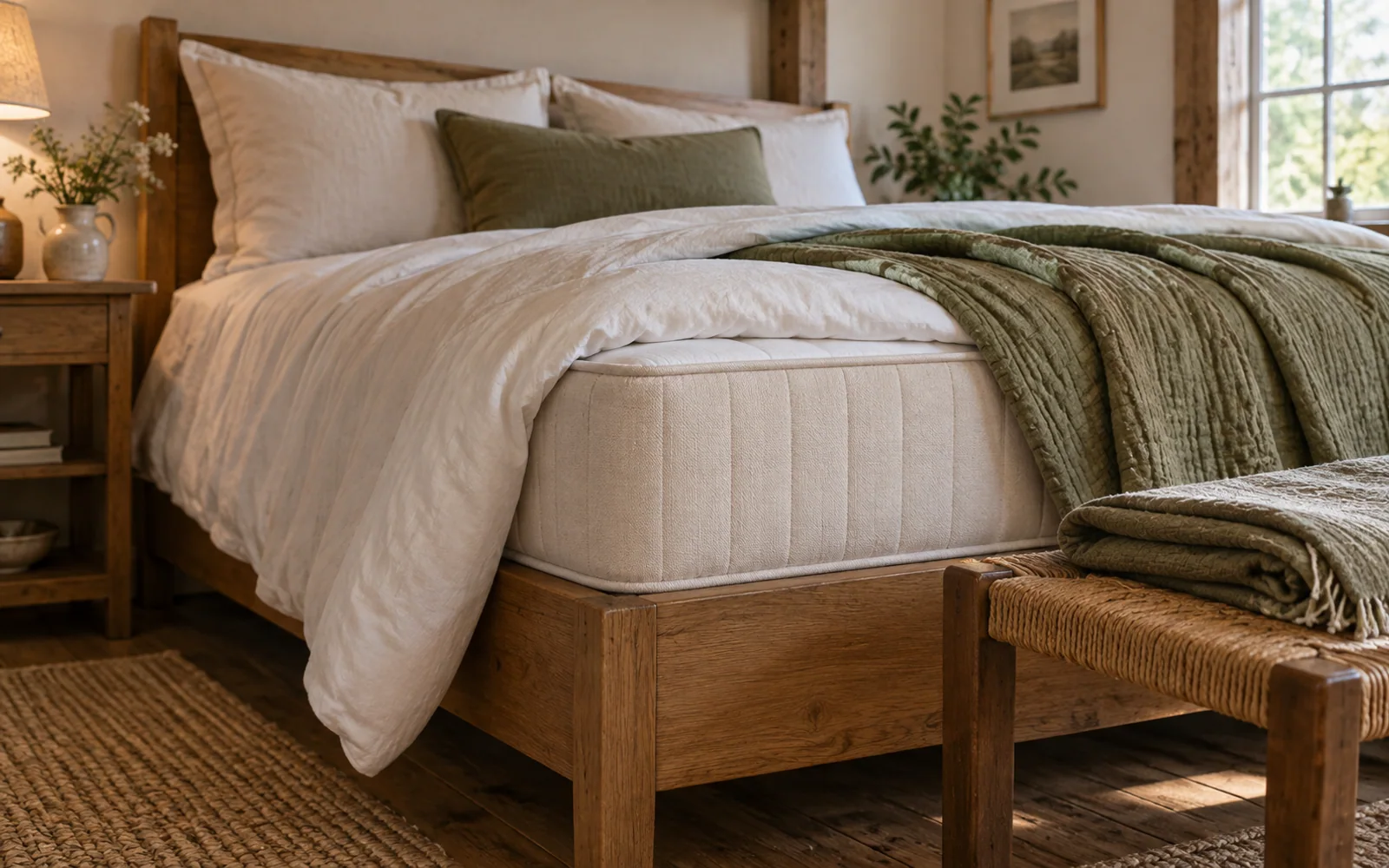
What Edge Support Is
Edge support refers to how firmly the perimeter of a mattress resists compression — both when you sit on the edge and when you sleep close to the side. A mattress with strong edges feels stable all the way to the seam; one with weak edges feels like sliding into a hole when you near the outside.
On a typical queen mattress (60 inches wide), weak edge support effectively reduces usable sleeping width to roughly 52 inches because the outer 4 inches sag too much to comfortably sleep on. For couples especially, that's a meaningful loss.
How Edge Support Is Built
Different mattress types use different edge-support strategies:
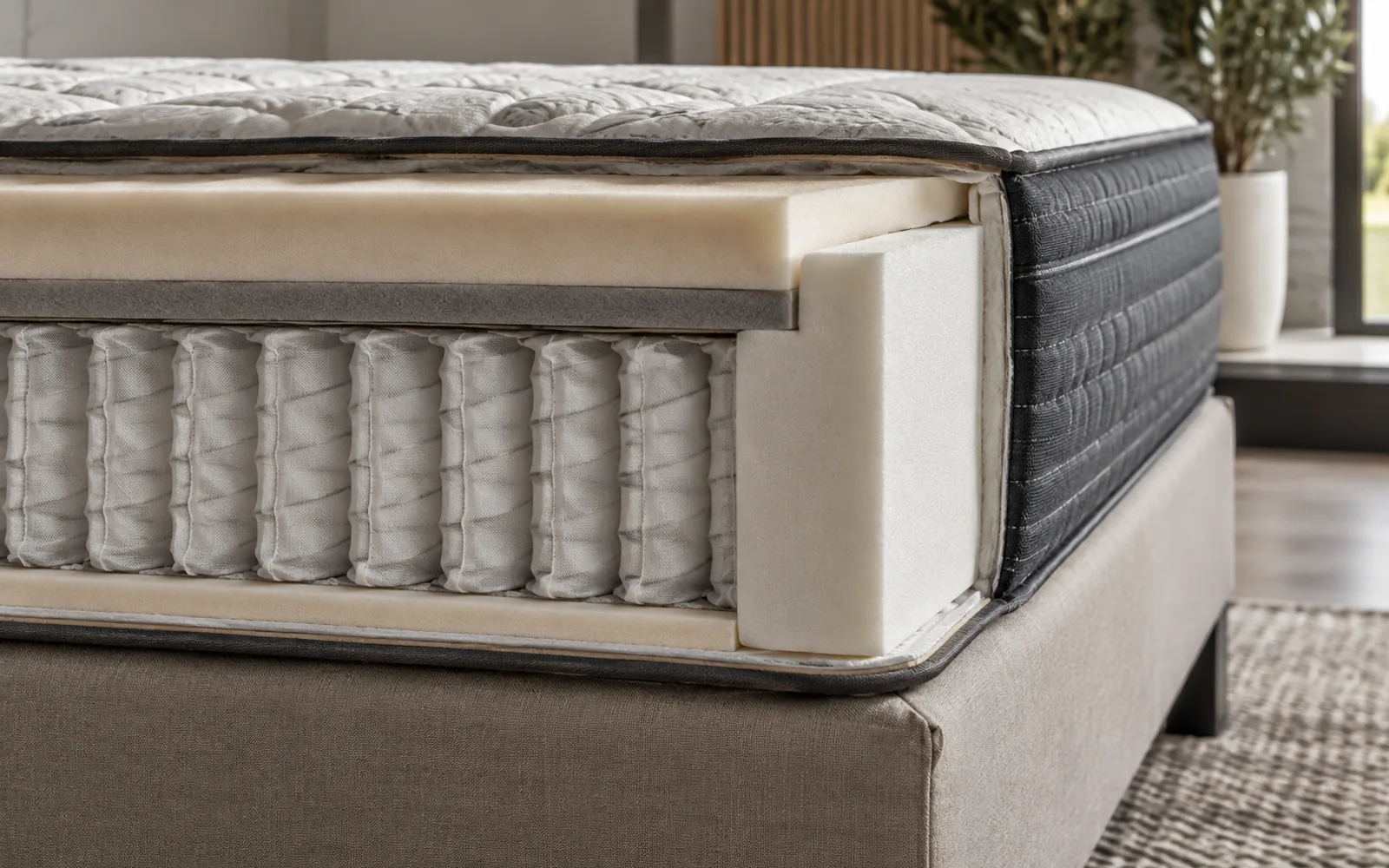
Innerspring and hybrid
Either reinforced perimeter coils (firmer pocketed coils around the edges than the center) or a foam encasement (a high-density foam wall around the coil system). Foam encasement is more common in modern hybrids; reinforced coil perimeters are common in higher-end innerspring.
All-foam memory foam
Most all-foam mattresses have weaker edges than hybrids because foam compresses uniformly. Some brands use a denser perimeter foam or include a reinforcement layer; many don't. Edge support is generally a weak point for all-foam construction.
Latex
Latex has natural edge support because the material is denser and more resilient than memory foam. Most all-latex mattresses have decent edge support without specific reinforcement.
Airbeds
Edge support varies — Sleep Number uses a foam encasement around the air chambers that provides solid edge support. Lower-end airbeds without encasement have noticeably weaker edges.
Who Needs Strong Edge Support Most
Strongest case for prioritizing edge support
- Couples sharing a queen or smaller — every inch of usable surface matters
- Heavier sleepers (over 230 pounds) — edge sag is amplified at higher weight
- Older adults or anyone with mobility issues — sitting on the edge to get in and out of bed is much easier when the edge doesn't collapse
- People who sleep close to the edge for any reason (sharing with a pet, sleeping near a wall, partner who claims the center)
- Anyone who uses the bed for reading, watching TV, or working — sitting up on the edge is more comfortable with firm support
Less critical edge support
Single sleepers in a king or queen who sleep in the center, people who don't sit on the bed for activities other than sleep, and lighter sleepers (under 150 pounds) who don't compress edges as deeply. Edge support is still nice to have, but it's a lower priority than firmness, support, and material quality.
How to Evaluate Edge Support in a Trial
- 1Sit on the edge of the bed without bedding for 30 seconds — note how much you sink and whether the edge feels stable
- 2Lie down close to the side (within 4 inches of the edge) and shift positions — note whether you feel like you're about to roll off
- 3Sit on the corner and stand up — does the corner support your weight, or does it collapse?
- 4Compare to your previous mattress if you remember its edge feel
Edge support is something you can fairly evaluate from night one — it doesn't change much with break-in. If the edges feel weak in the first week, they'll continue to feel weak.
Brands and Models Known for Strong Edge Support
This is a non-exhaustive overview — not endorsements — of construction approaches that historically test well for edge support:
- Saatva Classic — uses an edge support system with high-density foam encasement around the coil system
- Helix Luxe series — foam-encased perimeter on hybrid models, providing strong edge support
- Stearns & Foster (most models) — traditional reinforced perimeter coils plus foam edge
- Beautyrest Black hybrid models — perimeter pocketed coils that are firmer than the center field
- Brooklyn Bedding Aurora Hybrid — foam encasement around pocketed coils
- Avocado Green Mattress — wool batting plus dense organic foam at the perimeter
- Sleep Number — foam encasement around the air chambers
Most all-foam memory foam mattresses — Nectar, Casper Original, Tuft & Needle — have weaker edge support by construction. They can still be excellent sleep surfaces; they're just not the first choice for sleepers who specifically need strong edges.
How Bad Edge Support Affects Daily Use
- Sitting on the side of the bed to put on shoes — you sink in awkwardly and the edge feels unstable
- Sleeping near the edge — you feel like you're rolling off, which disrupts deep sleep
- Couples sleeping close to opposite edges — both partners have less usable space than the mattress width suggests
- Getting in and out at night — the unstable edge makes it harder to push off, especially for heavier sleepers or anyone with hip or knee issues
Can Edge Support Be Improved After Purchase?
Mostly no — it's a construction feature, not something you can add. A few partial workarounds:
Partial workarounds
- A firmer foundation can slightly improve edge feel by reducing how much the mattress sags overall
- Bed rails (more common on hospital and luxury frames) physically prevent rolling off the edge, though they don't make the edge firmer
- A topper covering the full mattress can help marginally — but a topper that's too soft can actually worsen edge sag
If edge support is critical to your daily use and your current mattress doesn't provide it, replacement is usually the right path. Edge support is hard to retrofit.
What the Edge Doesn't Affect
Edge support is unrelated to:
- Center-of-bed comfort — most of your sleep happens in the middle, where edge support is irrelevant
- Motion isolation — that's a separate property of the comfort layer and coil isolation
- Cooling — edge construction doesn't meaningfully affect airflow
- Durability of the rest of the mattress — but the edges themselves can fail before the center on weakly-supported mattresses
The Practical Recommendation
If you're a couple in a queen, a heavier sleeper, an older adult, or anyone who routinely uses the edges of the bed, prioritize edge support in mattress selection. Read independent reviews specifically for edge support comments, look for foam-encased hybrid construction, and test the edge feel in the first week of your trial. For single sleepers in a king who don't use the edges, edge support is a nice-to-have rather than a deciding factor.
The couples guide covers edge support alongside motion isolation and partner-shared considerations.
Read: Best Mattress for Couples →Couples-rated mattresses prioritize edge support — see the picks ranked specifically on that metric.
Best Mattresses for Couples →Not sure where to start?
Take our quick sleep quiz and we'll match you with mattresses that fit your sleep style and budget — no jargon, no upsell.
Find your perfect sleep →