
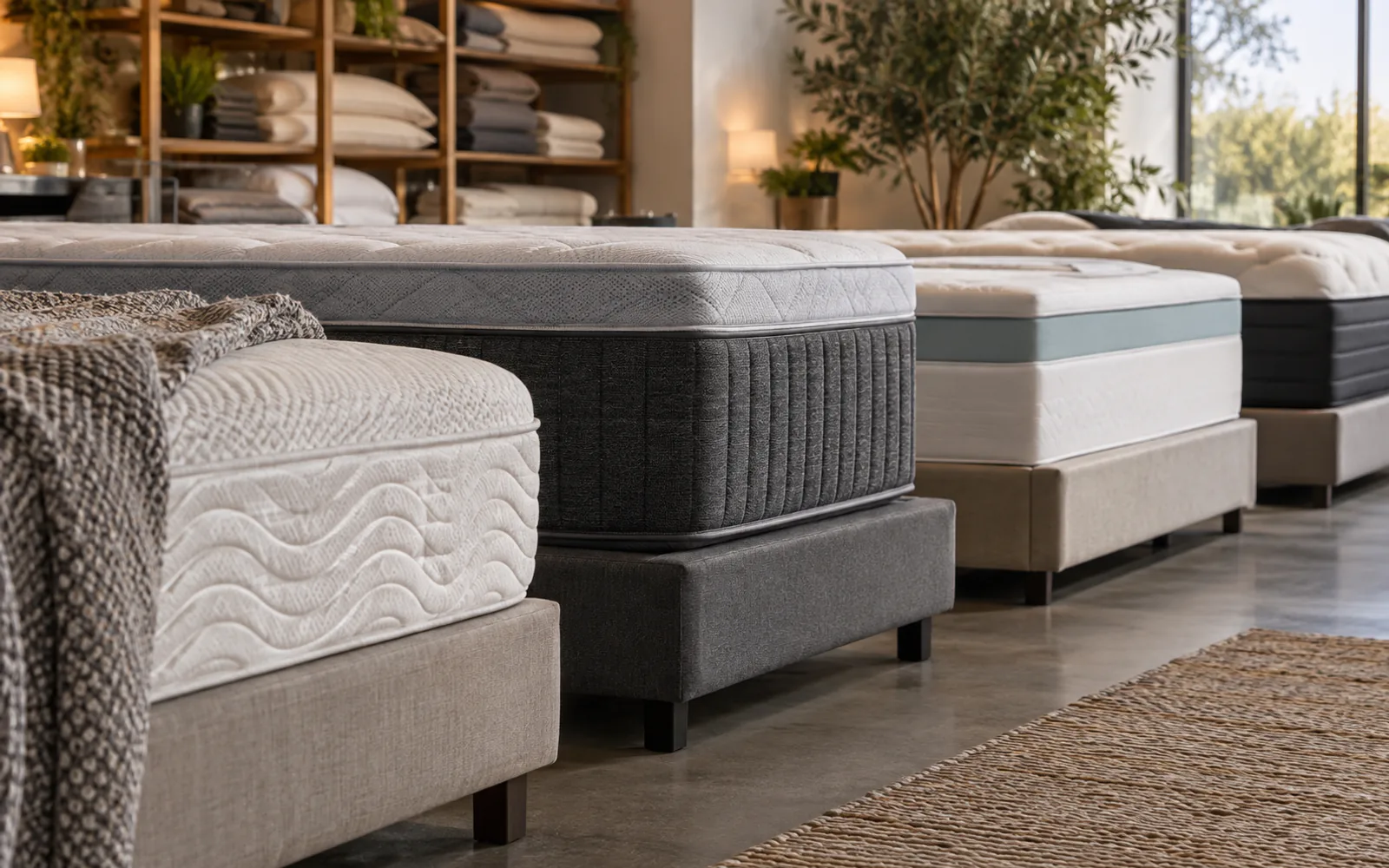
The Standard Thickness Range
Thickness categories
- 6 to 8 inches: Slim — bunk beds, RVs, kids' rooms, guest rooms; not designed for everyday adult use
- 9 to 10 inches: Standard — entry-level adult mattresses; works for lighter sleepers and most kids
- 11 to 12 inches: Standard-plus — the most commonly chosen thickness range for adult sleepers
- 13 to 14 inches: Thick — premium hybrids and luxury memory foam; common for heavier sleepers and couples
- 15 inches and up: Extra-thick — pillow-tops and ultra-premium constructions; aesthetic premium, mixed practical value
What Mattress Thickness Actually Determines
Three real-world effects depend on thickness:
What thickness affects
- Support depth for heavier sleepers — thicker mattresses don't bottom out as easily under higher body weight
- Bed height — combined with the foundation, this determines how easy it is to get in and out
- Layer count — thicker mattresses can stack more specialized layers (comfort, transition, support)
Three things thickness does NOT determine: comfort, durability, or back-pain performance. Those depend on material quality and construction, not depth.
By Body Weight
Under 130 Pounds
Lighter sleepers don't compress mattresses deeply, so a 10-inch quality mattress provides ample support. There's no functional benefit to going thicker than 12 inches in this weight range — the extra material adds cost without changing the sleep surface that matters.
130 to 230 Pounds (Average Range)
10 to 12 inches is the sweet spot for most adult sleepers in this range. Memory foam mattresses lean toward the higher end (12 inches gives room for adequate transition foam under the contouring comfort layer); hybrids work well at 11 to 13 inches depending on coil and comfort layer depth.
230 Pounds and Up
Heavier sleepers benefit from 12 to 14 inches. Thicker mattresses with high-density support cores resist compression all the way through, preventing the bottoming-out sensation that develops on thinner mattresses under more weight. Sub-12-inch mattresses for heavier sleepers tend to develop body impressions faster.
By Sleep Position
Sleep position has a less direct effect on ideal thickness than body weight does, but there are tendencies:
- Side sleepers benefit slightly from thicker constructions (12 to 14 inches) because the comfort layer needs depth to contour the hip and shoulder without bottoming out — the hip and shoulder need 3 to 4 inches of compression room
- Back sleepers do well in 10 to 12 inches — too-thick mattresses can over-contour the lumbar curve
- Stomach sleepers prefer firmer, thinner constructions (9 to 11 inches) — too-deep contouring lets the hips sink and bows the lumbar spine
- Combination sleepers usually do best at 11 to 13 inches with responsive material that doesn't make changing positions feel like sinking
Bed Height: The Functional Argument
Total sleeping height (floor to top of mattress) affects how easy it is to get in and out of bed. For most adults, the sweet spot is 25 to 33 inches total — roughly knee-height when standing, which makes sitting on the bed comfortable and getting up easy.
Adding up the total height
Mattress thickness + foundation height = total sleeping height. A 12-inch mattress on an 8-inch foundation is 20 inches total — workable but on the low side. A 14-inch mattress on a 14-inch box spring is 28 inches total — comfortable for most adults. A 16-inch mattress on a 14-inch box spring is 30 inches — fine for most, slightly tall for very short sleepers.
For older adults or anyone with mobility issues, lower is usually better — a 24 to 27 inch total height puts the bed at chair height, making it easy to sit down and stand up. For tall sleepers (6'2"+), higher is usually more comfortable — a 30 to 33 inch total puts the bed at upper-thigh height.
The Layer-Count Argument
Thicker mattresses have room to stack more specialized layers. A premium 14-inch hybrid commonly has:
- 1 to 2 inches of comfort layer (contouring foam)
- 2 to 3 inches of transition foam (transition from soft to firm)
- 6 to 8 inches of pocketed coils (support core)
- 1 to 2 inches of base foam (coil isolation and base structure)
A budget 10-inch all-foam mattress commonly has:
- 1.5 inches of memory foam comfort layer
- 2 inches of transition foam
- 6.5 inches of base polyurethane foam
The extra inches in the premium hybrid go toward more specialized materials. That can improve comfort and durability — but only if the materials themselves are quality. Brands sometimes inflate thickness with low-density filler foam that adds height without performance.
Why Thicker Isn't Always Better
Drawbacks of going too thick
- Higher cost without proportionally better sleep
- Heavier and harder to rotate, move, and replace fitted sheets on (most fitted sheets are made for up to 14 to 16 inches; ultra-thick mattresses require deep-pocket or extra-deep-pocket sheets)
- Combined bed height that's too tall for shorter sleepers or older adults
- Some adjustable bases have weight or thickness limits — over-thick mattresses can interfere with articulation
Drawbacks of going too thin
- Bottoming-out feel under heavier sleepers
- Less material depth means faster body impressions and shorter useful comfort lifespan
- Bed height may be too low for comfortable sit-to-stand
- Fewer construction options — most premium foam and hybrid features need at least 11 inches to fit
Special Cases
Bunk Beds and Loft Beds
Stick to 6 to 8 inches for safety. Most bunk beds have a safety rail height that assumes a thin mattress; a thicker mattress reduces the protective height above the surface, increasing fall risk. Bunk-specific mattresses are explicitly designed for this depth range.
RVs and Boats
8 to 10 inches is typical. Some RVs have non-standard mattress dimensions and storage areas that won't accept thick mattresses. Check both width-length AND maximum thickness against the RV's specifications.
Sofa Beds
Sofa-bed mattresses are 4 to 6 inches — limited by the fold mechanism. Toppers can add 2 inches of comfort without interfering with folding, but anything thicker prevents the bed from converting back into a sofa.
Adjustable Bases
Most adjustable bases accommodate up to 14 inches of mattress thickness without issue. Over 14 inches, the articulation angle decreases (the head doesn't tilt up as far) and some thicker hybrid mattresses don't bend smoothly. Check the adjustable base's thickness recommendation before pairing.
Reading Brand Thickness Numbers Critically
Two mattresses both labeled '12 inches' can have very different constructions. Compare the breakdown by layer when it's listed. Brands that publish layer-by-layer specs (Helix, Saatva, Brooklyn Bedding, Avocado) usually deserve more confidence than brands that publish only the total thickness.
Look specifically for the density of foam layers (lb/ft³) — high-density foam at 11 inches will outlast low-density foam at 14 inches. The Mattress Underground forum maintains crowd-sourced spec sheets for most major models that go deeper than the brand's published specs.
The Practical Recommendation
For most adult sleepers, 11 to 13 inches is the sweet spot. Heavier sleepers should lean toward 12 to 14 inches. Anyone with mobility issues should pay attention to total bed height and choose foundation accordingly. The right mattress is the one with the right materials at the right thickness for your body — not the thickest one on the page.
The quiz narrows mattresses by sleep position, weight, and material — thickness is a downstream consideration.
Take the Sleep Quiz →Not sure where to start?
Take our quick sleep quiz and we'll match you with mattresses that fit your sleep style and budget — no jargon, no upsell.
Find your perfect sleep →