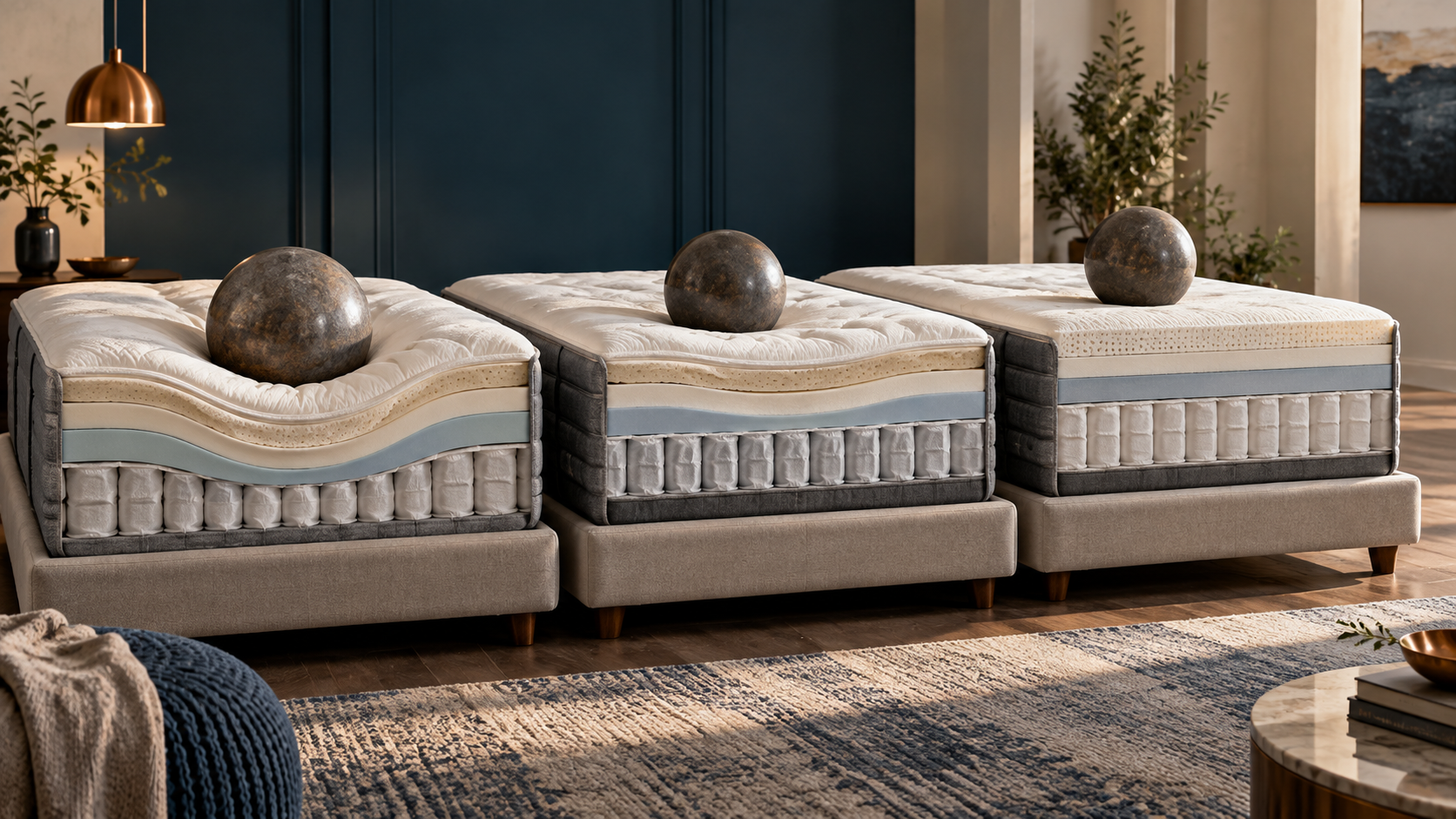
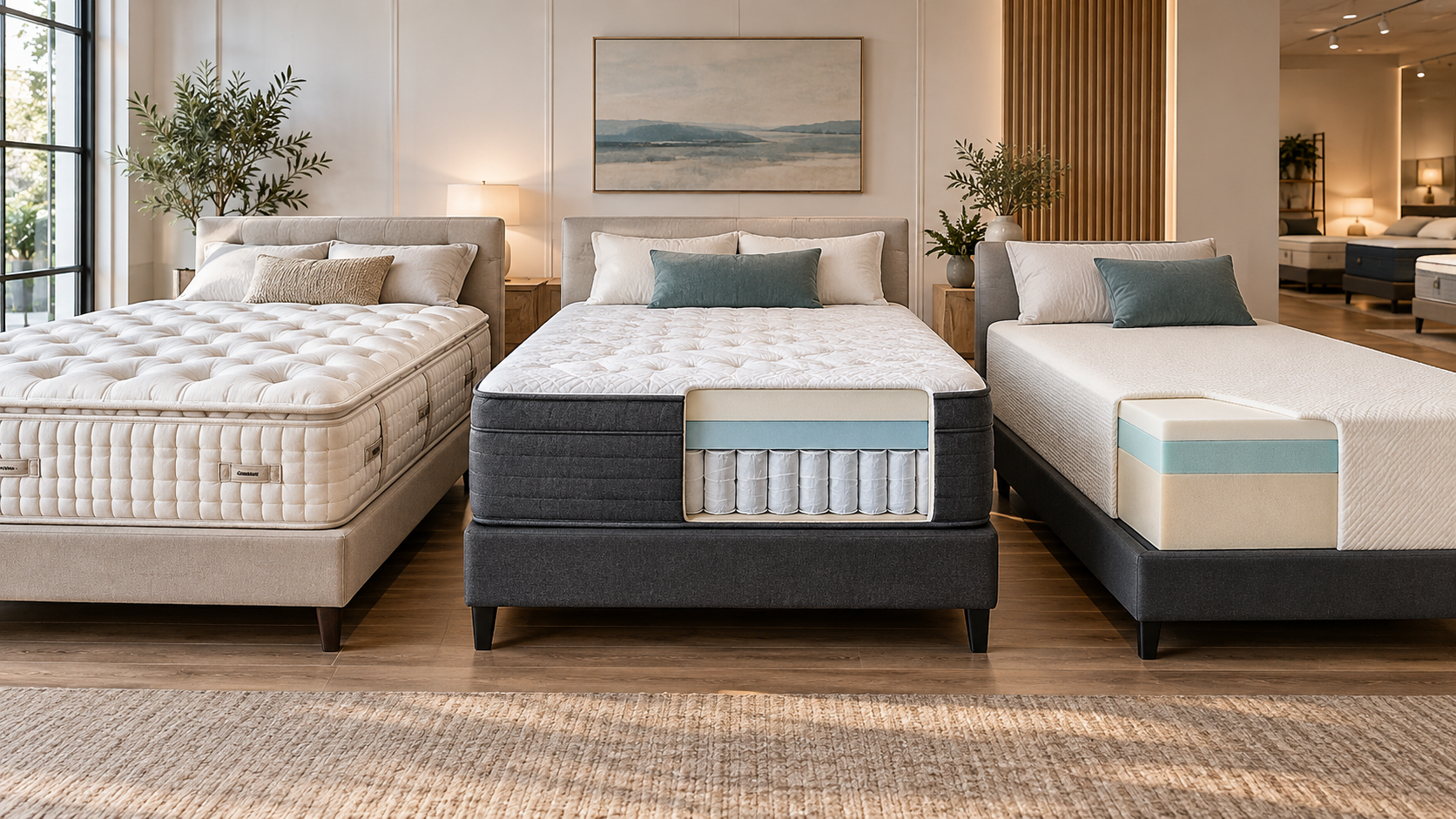

Quick answer
Treat 1 to 10 as descriptive ranges: 1–2 very soft, 3–4 soft or plush, 5–6 medium, 7–8 firm, and 9–10 extra firm. These are comparison labels, not lab-calibrated grades. They are most reliable when you compare options made by the same company in the same product line.
What the 1-to-10 Firmness Scale Can—and Cannot—Tell You
Common descriptive ranges
- 1–2: Very soft. Deep initial give; uncommon as a primary adult mattress feel.
- 3–4: Soft or plush. More surface cushioning and easier shoulder or hip immersion.
- 5–6: Medium. A balance of visible contour and surface resistance.
- 7–8: Firm. Less initial give and a more on-top-of-the-bed response.
- 9–10: Extra firm. Very little surface give; uncommon in mainstream online lineups.
No industry-wide machine, load, or panel makes these numbers interchangeable. Even the boundary between medium and medium-firm is editorial language. A number helps you compare the Plush Soft, Luxury Firm, and Firm versions of one mattress; it cannot guarantee that another company's 6 will match.
Why Two Mattresses With the Same Number Can Feel Different
- Comfort-layer depth: two inches of cushioning and four inches of cushioning can reach the support core differently.
- Material response: slow-moving memory foam, resilient latex, quilting, and microcoils can create different contour and rebound at a similar headline rating.
- Support design: zoning, coil geometry, edge reinforcement, and the transition layer affect where the mattress resists compression.
- Setup: the foundation, mattress protector, topper, and even an incompatible base can change the result you feel.
- Temperature: some viscoelastic foams respond differently as the room and material warm, while other materials are less temperature-sensitive.
- Your loading pattern: body size, shape, sleep position, and pillow height change which areas compress first and by how much.
A Five-Step Way to Choose Firmness
- 1Start with the bed you know. Write down whether your current mattress creates too much pressure, lets the midsection sink too far, restricts turning, or simply feels comfortable.
- 2Use sleep position as a directional clue. Side sleeping needs usable shoulder and hip give; back sleeping needs contour with stable midsection support; stomach sleeping needs enough resistance to limit uncomfortable midsection sink; combination sleeping also rewards easy movement.
- 3Watch the response instead of doing body-weight math. Notice whether you bottom through the comfort layer, feel held up before the shoulder or hip settles, or struggle to change position.
- 4Compare firmness choices within the same product line when possible. That holds more of the construction constant, so the feel option is a cleaner variable.
- 5Read the exact seller policy before ordering. Confirm minimum-use rules, exchange fees, pickup or shipping costs, foundation requirements, damage exclusions, and whether an exchange changes future return rights.
Sleep Position Is a Starting Clue, Not a Number Prescription
What to check in your usual position
- Side: Does the shoulder and hip settle without sharp pressure or obvious bottoming through the comfort layers?
- Back: Does the surface contour without letting the midsection feel unsupported or forcing the lower back into an uncomfortable position?
- Stomach: Does the midsection stay stable enough for comfort without creating concentrated pressure elsewhere?
- Combination: Can you turn without fighting the surface, and does every regularly used position remain comfortable?
Those checks are intentionally about the mattress response. A rule such as 'every side sleeper needs a 4' ignores large differences in material, layer depth, body shape, pillow fit, and preference.
How Body Size Changes the Experience
A sleeper who applies more load to a particular area may compress the same comfort system more deeply, while a sleeper who applies less load may engage less of it. That does not justify a universal plus-one or minus-one rule. Two people at the same weight can load a bed differently because of height, shape, position, and where they carry weight.
Use observable fit signals
- Too little give: concentrated shoulder or hip pressure, or the sense that the surface stops the body before it settles comfortably.
- Too much give: bottoming through the comfort layers, a midsection that feels difficult to keep stable, or movement that feels unnecessarily effortful.
- Promising fit: comfortable pressure distribution, stable support in normal positions, and easy enough turning for your mobility needs.
Firmness and Support Are Different Decisions
Firmness describes the initial resistance or surface feel. Support describes how the full construction manages load. A hard surface can still distribute pressure poorly, and a cushioned surface can have a stable support core. Judge the comfort layers and support system separately instead of assuming firmer means better built or more supportive.
What the Back-Pain Research Actually Shows
A 2003 randomized trial followed 313 adults with chronic non-specific low-back pain and found better 90-day outcomes with a medium-firm mattress than with a firm mattress. The study used a European H(s) scale where 1 was firmest and 10 was softest—the reverse of common retailer shorthand. It cannot identify a current brand, model, or 1-to-10 shopping number for an individual.
Kovacs et al., The Lancet (2003): randomized mattress-firmness trial
A 2021 systematic review found that medium-firm mattresses were often associated with comfort, sleep quality, and alignment, while also emphasizing that the research used varied methods and did not establish one universal mattress design. Use that evidence to reject the idea that harder is always better—not to treat medium-firm as a medical prescription.
Caggiari et al. (2021): systematic review of mattresses, sleep quality, and back pain
Health boundary
A comfort guide cannot diagnose the cause of pain. Do not use a seller's minimum trial period as a reason to sleep through worsening symptoms. Seek medical advice for persistent, worsening, or concerning pain and contact the seller promptly about an unsuitable mattress.
A Cleaner Real-World Test: One Mattress, Three Feel Choices
Amerisleep sells the current AS6 in Plush Soft, Luxury Firm, and Firm versions. The named 14-inch construction and base product stay within the same family, so this is a more controlled firmness comparison than matching numbers across unrelated brands. The links below open the exact reviewed feel variant; confirm the selected feel, current price, delivery estimate, and return terms before paying.
AS6 Plush Soft
Compare Plush Soft when your main problem is that firmer surfaces stop your shoulder or hip before you settle comfortably. The trade-off is greater immersion and potentially more effort when turning.
AS6 Luxury Firm
Compare Luxury Firm when you want a middle feel within this exact lineup and neither deep surface give nor the firmest response clearly solves your current-bed problem. Middle does not guarantee universal fit; it is simply the center comparison point here.
AS6 Firm
Compare Firm when your current bed lets the midsection settle farther than feels comfortable or you prefer less initial surface give. The trade-off is less cushioning at pressure-sensitive areas.
💡 Prices change frequently. Click any mattress above to see today's deal.
When Partners Want Different Feels
If both partners can sleep comfortably on one option within the same line, a shared middle choice keeps the bed simple. If the compromise leaves one person consistently uncomfortable, compare a Split King or a modular design that permits separate sides. Account for the center seam, matching finished height, bedding, base compatibility, and separate return rules.
See the dimensions, base compatibility, bedding, seam, and return questions that matter before choosing separate sides.
Read the Split King guide →Use the Trial as a Structured Fit Check
- 1Save the order confirmation, selected firmness, delivery date, seller terms, and setup instructions.
- 2Use the approved foundation and confirm that the delivered model and firmness match the order.
- 3Try every position you use regularly. Note pressure, midsection stability, ease of turning, edge use, heat, and partner disturbance.
- 4Separate the mattress from other variables: pillow height, a thick protector, a topper, or an incompatible base can alter the experience.
- 5Contact the seller before the deadline if the feel is unsuitable. Get fees, pickup steps, exchange effects, and refund timing in writing.
Final recommendation
Shortlist by your current-bed problem, compare feel choices within one product line, and buy only when the exact seller terms make a wrong first choice recoverable. A firmness number can organize the options; it cannot replace an at-home fit check.
Need to compare materials before choosing a feel? Start with how foam, latex, coils, and hybrids change response.
Read Mattress Types Explained →Not sure where to start?
Take our quick sleep quiz and we'll match you with mattresses that fit your sleep style and budget — no jargon, no upsell.
Find your perfect sleep →