
What 'Hypoallergenic' Actually Means for Mattresses
Three distinct concerns get bundled under the hypoallergenic label, and they're addressed by different choices:
Three separate triggers
- Dust mites — microscopic creatures that feed on shed skin cells; the most common bedroom allergen
- Mold and mildew — develops in moisture-rich foam and on damp surfaces
- Chemical sensitivity — reaction to volatile organic compounds (VOCs) from new foam, adhesives, and flame-retardant treatments
A truly hypoallergenic-leaning mattress addresses all three. Most products marketed as hypoallergenic address one or two.
Materials That Are More Allergen-Resistant
Natural Latex (Dunlop or Talalay)
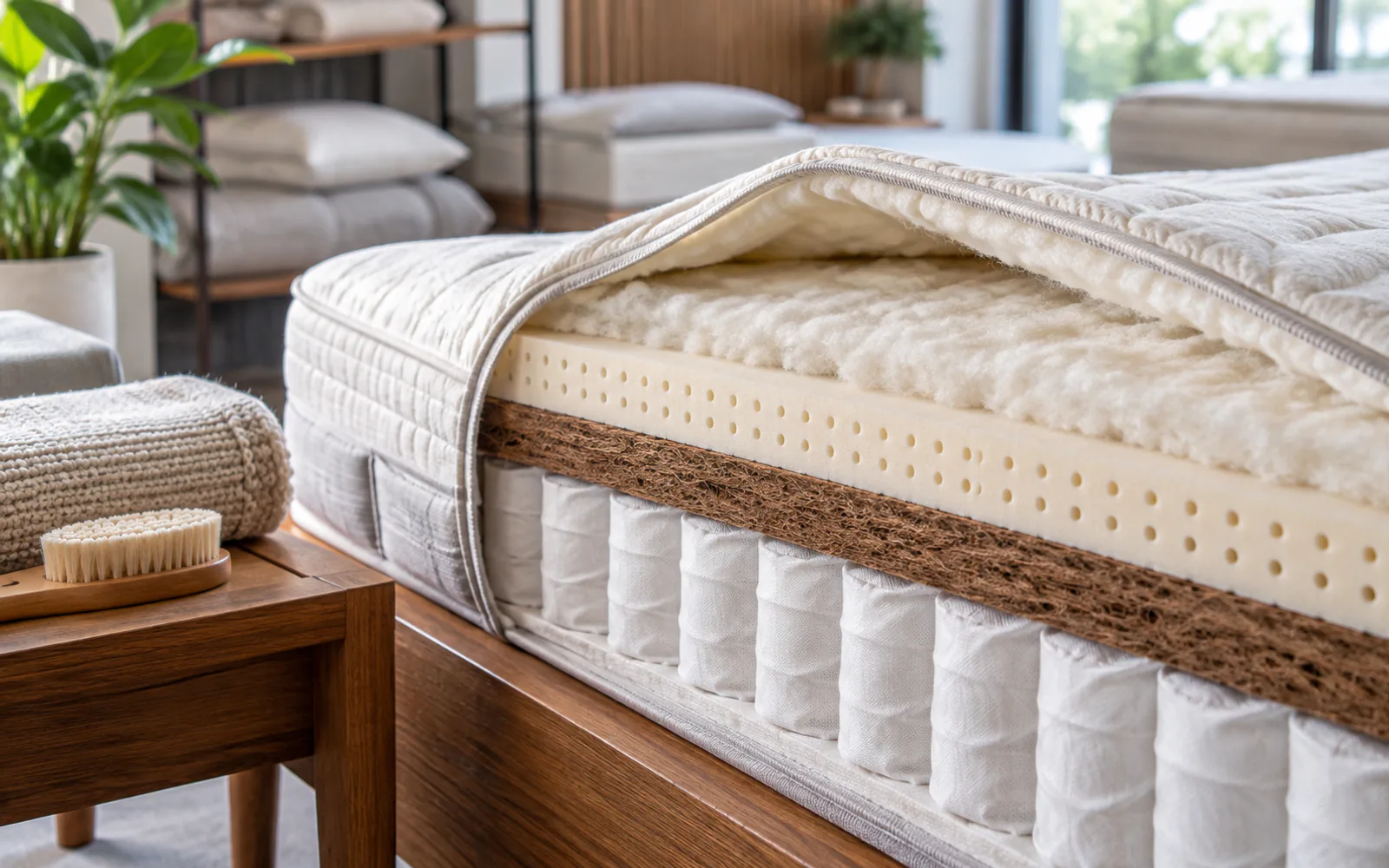
Natural latex from GOLS-certified sources is the most consistently hypoallergenic of common mattress materials. It's naturally resistant to dust mites (the cellular structure isn't hospitable), naturally resistant to mold and mildew (antimicrobial properties from the latex itself), and has the lowest off-gassing of any common mattress material once initial vanilla-like rubber smell fades.
Synthetic and blended latex has more off-gassing than natural latex and is somewhat less mold-resistant. For allergy considerations, the GOLS certification (or natural Talalay/Dunlop labeling) is the meaningful distinction.
Organic Cotton and Wool Covers
Mattress covers made from organic cotton (GOTS-certified) and wool batting are breathable and wick moisture away from the sleep surface. Wool specifically is naturally antimicrobial and dust-mite-resistant. The combination is common in mattresses from Avocado, Naturepedic, Birch, PlushBeds, and other organic-focused brands.
Certified Low-VOC Foam
For people sensitive to chemical off-gassing rather than dust mites or mold, the relevant certifications are CertiPUR-US (for polyurethane foam) and GREENGUARD Gold (for finished products). These cap VOC emissions to lower levels than uncertified products. They don't eliminate smell entirely, but the off-gassing window is shorter and the residual chemical inventory is smaller.
Materials That Are Less Allergen-Resistant
- Low-density polyfoam without certification — typically has the highest off-gassing of common materials
- Memory foam without CertiPUR-US or GREENGUARD Gold certification — VOC content is uncapped
- Pillow-top constructions with synthetic batting — can trap moisture and become a dust mite habitat over years
- Untreated wool that isn't washed at the source — can carry lanolin residues some people react to (a niche concern)
The Certifications That Matter
Mattress certifications relevant to allergy considerations
- GOLS (Global Organic Latex Standard) — organic certification specific to latex; lowest off-gassing of common materials
- GOTS (Global Organic Textile Standard) — for cotton, wool, and other natural fiber components in the cover
- OEKO-TEX Standard 100 — tests fabrics for harmful substances
- CertiPUR-US — caps VOC emissions and prohibited chemicals (PBDEs, mercury, lead, formaldehyde) in polyurethane foam
- GREENGUARD Gold — broader finished-product emission standard, including for assembled mattresses
- MADE SAFE — comprehensive material safety certification covering both health and environmental concerns
A mattress with multiple of these certifications is significantly more likely to meet hypoallergenic-leaning expectations than one with none.
Brands With Hypoallergenic-Leaning Lineups
This is a non-exhaustive overview of brands frequently chosen for allergen considerations — not endorsements:
- Avocado Green Mattress — GOLS latex, GOTS organic cotton, wool batting; multiple certifications
- Naturepedic — organic cotton and wool, latex options, no polyurethane in many models, MADE SAFE certified
- PlushBeds Botanical Bliss — GOLS natural latex, GOTS organic cotton cover
- Brentwood Home — organic cotton and wool, several latex models
- Birch by Helix — organic wool, organic cotton, natural Talalay latex hybrid construction
- Saatva Latex Hybrid — natural Talalay latex over coils; not fully organic but lower-VOC than many
If the goal is fully organic and low-allergen, look for brands with multiple certifications and transparency about every layer. Brands that publish detailed material specs at every layer (rather than just the cover) tend to be more credible than brands that label a mattress 'hypoallergenic' without showing what's inside.
Care Habits That Reduce Allergens
Reduce dust mites, mold, and accumulated allergens
- Use an allergen-proof zippered encasement (pore size under 10 microns)
- Wash sheets weekly in hot water (130°F or hotter)
- Wash the encasement every 2 to 4 weeks
- Vacuum the mattress monthly with a HEPA-filter vacuum
- Keep bedroom humidity under 50 percent
- Run a HEPA air purifier in the bedroom
- Replace pillows every 2 to 3 years (pillows accumulate allergens faster than mattresses)
The dust-mite-reduction guide covers the encasement, washing, and humidity strategies in more depth.
Read: How to Reduce Dust Mites in Bed →Mold and Mildew Prevention
For sleepers concerned about mold sensitivity, the prevention strategies overlap with general mattress care:
- Use a slatted foundation with airflow underneath the mattress (no solid platform or floor placement)
- Install a breathable moisture-wicking protector
- Keep bedroom humidity under 50 percent
- Address any spill or sweat soaking within hours
- Avoid storing the mattress in sealed plastic
- Choose latex or naturally moisture-resistant materials in humid climates
If mold is already a concern, the identification and cleaning guide covers what's safely recoverable and what isn't.
Read: How to Deal With Mold on a Mattress →Chemical Sensitivity Considerations
For people sensitive to chemical off-gassing, three practical strategies:
Reduce VOC exposure
- Choose CertiPUR-US, GREENGUARD Gold, OEKO-TEX, or GOLS-certified mattresses
- Unbox and let the mattress air for 1 to 2 weeks in a spare room before sleeping on it
- Use the trial period if the chemical smell hasn't faded after 4 weeks of ventilation
- Consider natural latex, which has the lowest off-gassing of common materials
The off-gassing guide covers what's normal, what's not, and when to escalate to the brand.
Read: How to Speed Up Mattress Off-Gassing →What 'Hypoallergenic' Doesn't Mean
Marketing language to read skeptically:
- 'Hypoallergenic cover' on a mattress with non-certified foam underneath — the cover is one piece of the construction; the foam below it matters too
- 'Antimicrobial treatment' on a foam mattress — chemical treatments can introduce allergens of their own and aren't a substitute for naturally resistant materials
- 'Allergy-friendly' with no certification — no industry standard backs this term
- 'Plant-based foam' — usually means a small percentage of plant-derived material in otherwise standard polyurethane foam; not the same as natural latex
Medical Considerations
This guide covers materials and care strategies that reduce common allergens. It is not a substitute for medical care. People with diagnosed allergies, asthma, or chronic respiratory conditions should work with an allergist and primary care physician on a comprehensive plan that includes bedroom environment but also broader health management. A mattress is one piece of the larger picture, not the whole solution.
If you're considering a mattress purchase specifically because of allergy symptoms, the right sequence is usually: see a doctor first to confirm the trigger, then choose a mattress that addresses the specific trigger (dust mite encasement and washing routine for dust mite allergy; low-VOC certified mattress for chemical sensitivity; latex or wool for combined concerns).
If your current mattress is older than 8 years, consider replacement as part of the overall reset — older mattresses accumulate more allergens regardless of material.
Read: How Long Does a Mattress Last? →Not sure where to start?
Take our quick sleep quiz and we'll match you with mattresses that fit your sleep style and budget — no jargon, no upsell.
Find your perfect sleep →